The St. Anne Weather Center
The St. Anne Weather Center stands out as the first facility to treat the atmosphere as a multi‑layered intelligence system rather than a passive fluid, and any seasoned meteorologist will recognize the significance of integrating classical dynamics with chemical, biological, and genomic measurements into a single predictive matrix. Its ABPI and HALOGEN‑F frameworks push forecasting into a quantum‑age discipline where wind isn’t just motion but information, and the precision of its sensor architecture reflects the kind of metrological rigor that defines the future of atmospheric science.

Directive Management
In this definitive review of the May 9, 2026, Hon. Tyree J. Mason I masterfully articulates the transition from territorial governance to a Distributed Sovereign Infrastructure (DSI), framing it as the modern successor to the Roman provincial model.
By equating ancient grain territories with contemporary energy-compute zones and substituting physical legions with cybersecurity protocols, the report posits that 21st-century sovereignty is predicated on the control of abstractions—intellectual property, data governance, and computational jurisdiction.
Mason’s architectural vision of "System-as-Environment" effectively addresses the strategic tension between localized resource burdens and global infrastructure demands, ultimately arguing for a resilient, algorithmically coordinated "Civilizational Operating System" that prioritizes shared protocol and autonomous execution over rigid imperial domination.

Directive on Sovereign Resource
The "Directive on Sovereign Resource Protection & Economic Jurisdiction," authored by Hon. Tyree J. Mason I on May 8, 2026, serves as a critical structural analysis of the "technological drainage" threatening domestic energy and land integrity. The report successfully synthesizes Sullan historical precedents with modern case studies in Michigan and Ohio to define the asymmetrical extraction of U.S. resources as a state of economic war, ultimately mandating the immediate implementation of the ACT Framework and AERION CORE technology to restore national sovereignty through atmospheric energy independence. With 54% of the world's data centers in the U.S., the plantation of slavery, with foreign owners and interests, has taken on a new face. This economic report begins to remove that mask.

No Orders, No Master
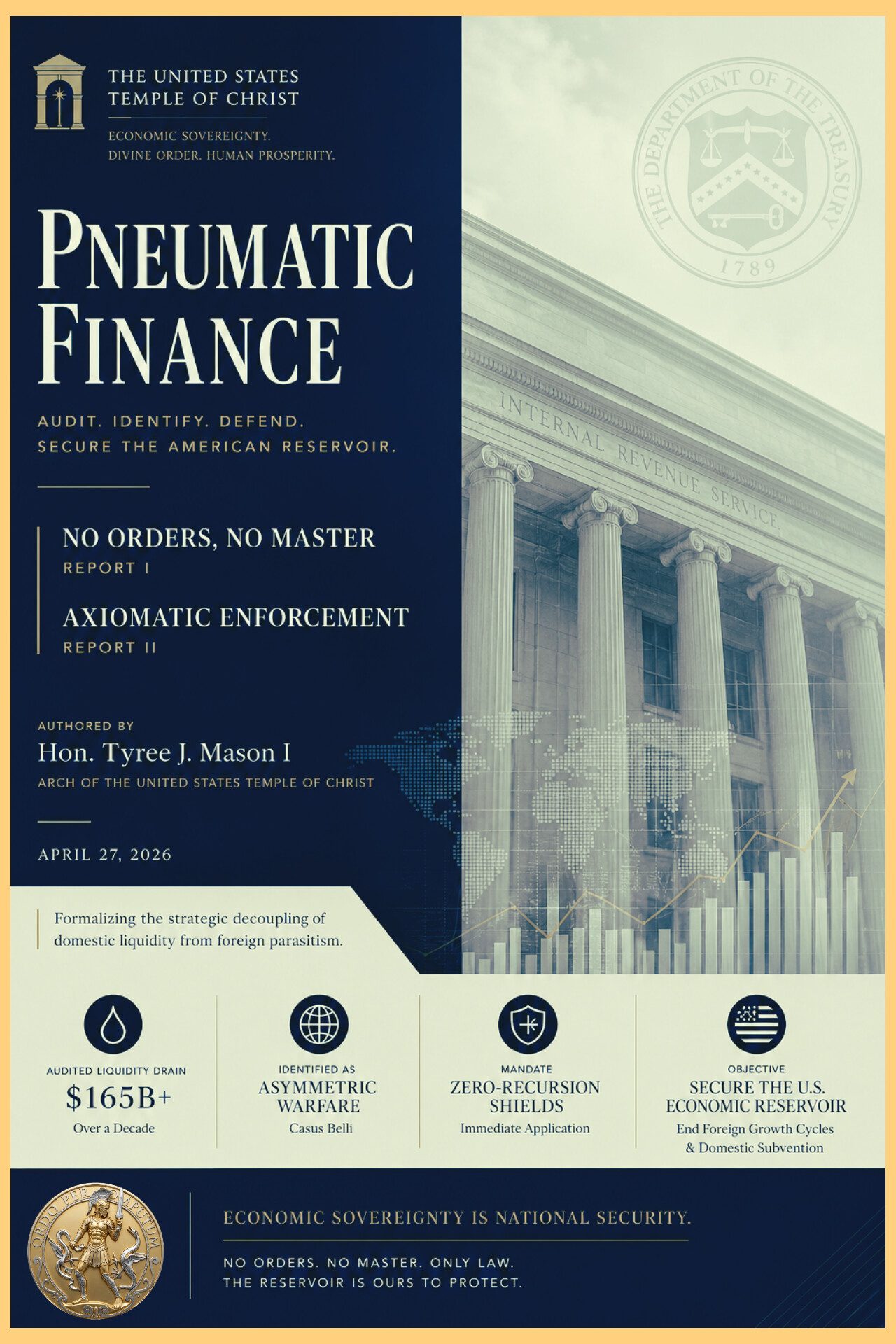
On April 27, 2026, Hon. Tyree J. Mason I, Arch of The United States Temple of Christ, formalized the strategic decoupling of domestic liquidity from foreign parasitism through the release of two foundational financial reports: No Orders, No Master and Axiomatic Enforcement, These documents utilize the principles of Pneumatic Finance to audit a decadal $165B+ liquidity drain, identifying the systemic conversion of American liquid energy into foreign land instrumentation as a casus belli. By classifying non-reciprocal capital extraction as an act of asymmetric warfare and identifying a primary foreign antagonist, these reports mandate the immediate application of Zero-Recursion Shields to secure the U.S. economic reservoir against foreign growth cycles and domestic subvention.
FOURTH DISTRICT ECONOMY
This report, authored by Hon. Tyree J. Mason I, Director of the Bureau of Computum Analysis (BCA) and Governor of Mason Mint & Clearing House, provides a comprehensive, forward-looking analysis of the Fourth District’s economy, integrating sectoral forecasts for employment, healthcare, transportation, and agriculture with a dual-layer global-local strategic framework. It outlines the region’s capacity to leverage innovation, infrastructure, and workforce adaptability to achieve sustainable local growth while actively engaging with global markets. Issued April 9, 2026.
THE BAYESIAN-MASON MODEL
Dated April 8, 2026, The Bayesian – Mason Strategic Approach to Capital Markets by Hon. Tyree J. Mason I, Director of the Bureau of Computum Analysis (BCA) and Governor of Mason Mint & Clearing House, presents a disciplined examination of probabilistic inference within modern financial systems, drawing on insights from Bank for International Settlements research to evaluate the current limitations of quantum computational methods relative to established techniques such as Markov Chain Monte Carlo while outlining a forward-leaning framework that signals the emergence of more adaptive, hybridized architectures capable of reshaping capital allocation, risk modeling, and strategic liquidity execution.
Policy at the Edge
Dated April 7, 2026 and authored by Hon. Tyree J. Mason I, Director of the Bureau of Computum Analysis and Governor of the Mason Mint & Clearing House, this report outlines how global monetary authorities are navigating a new macroeconomic regime defined by persistent inflation, heightened geopolitical shocks, and the rising risk of monetary overcorrection, presenting a dual‑risk framework, a regime‑based analytical model, and strategic allocation principles for operating within an increasingly fragmented and structurally volatile global economy.
SUPPLY SOVEREIGNTY
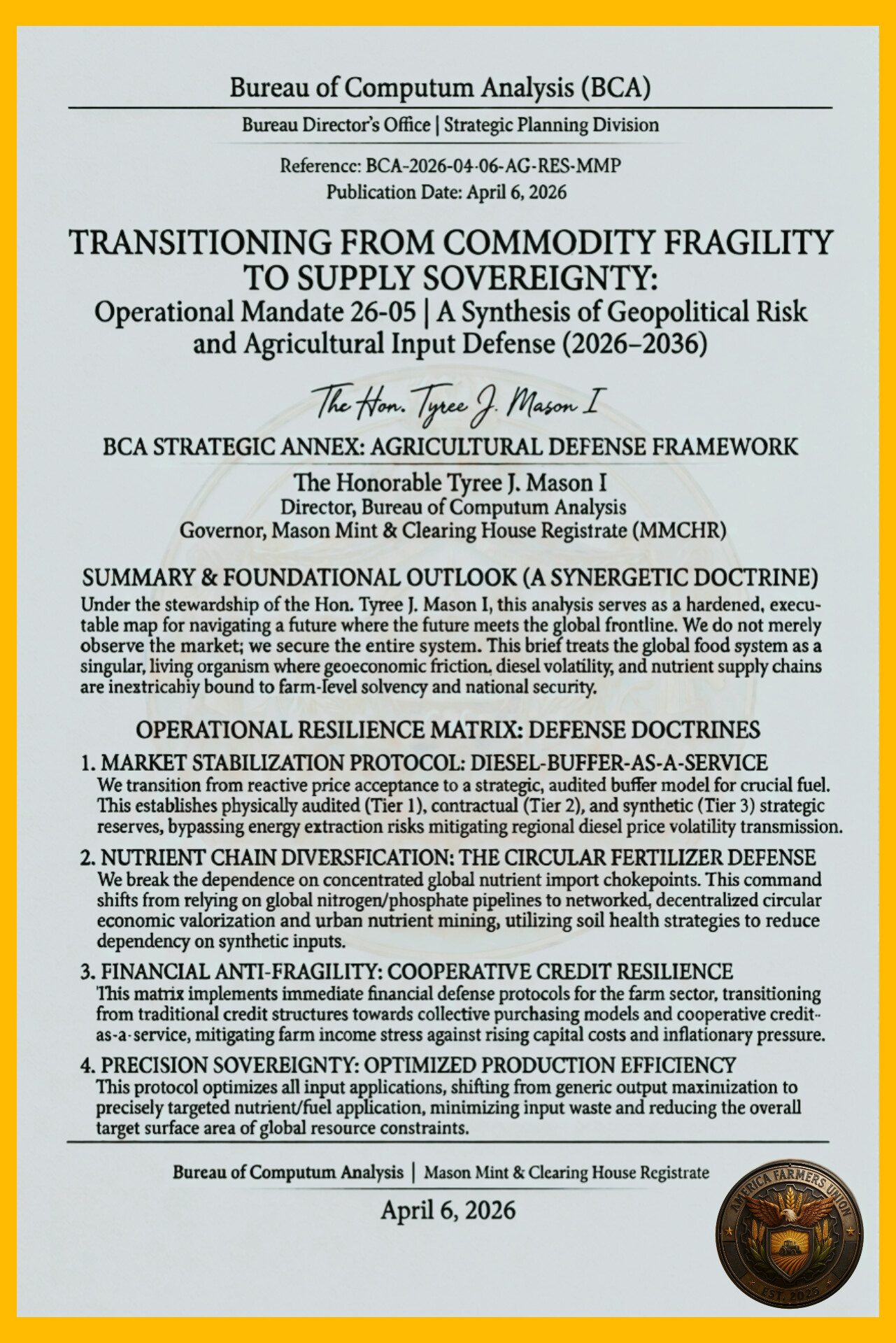
Prepared by Hon. Tyree J. Mason I, Director of the Bureau of Computum Analysis and Governor of the Mason Mint & Clearing House, this brief—dated April 6, 2026—pulls together global risk intelligence, energy and fertilizer outlooks, farm‑sector financials, and shifting trade patterns into a clear-eyed assessment of the decade ahead.
It speaks in the tone of someone who knows that volatility is nothing new: markets tighten, inputs swing, and geopolitics shifts like a stubborn season, yet agriculture endures because its stewards manage the whole system with discipline and foresight.
The report underscores that resilience isn’t a slogan but a practiced craft—one built by treating energy, soil, capital, and global supply lines as a single, interdependent field that can be tended, strengthened, and carried forward no matter how rough the weather turns.
Intertwined Risks of Climate
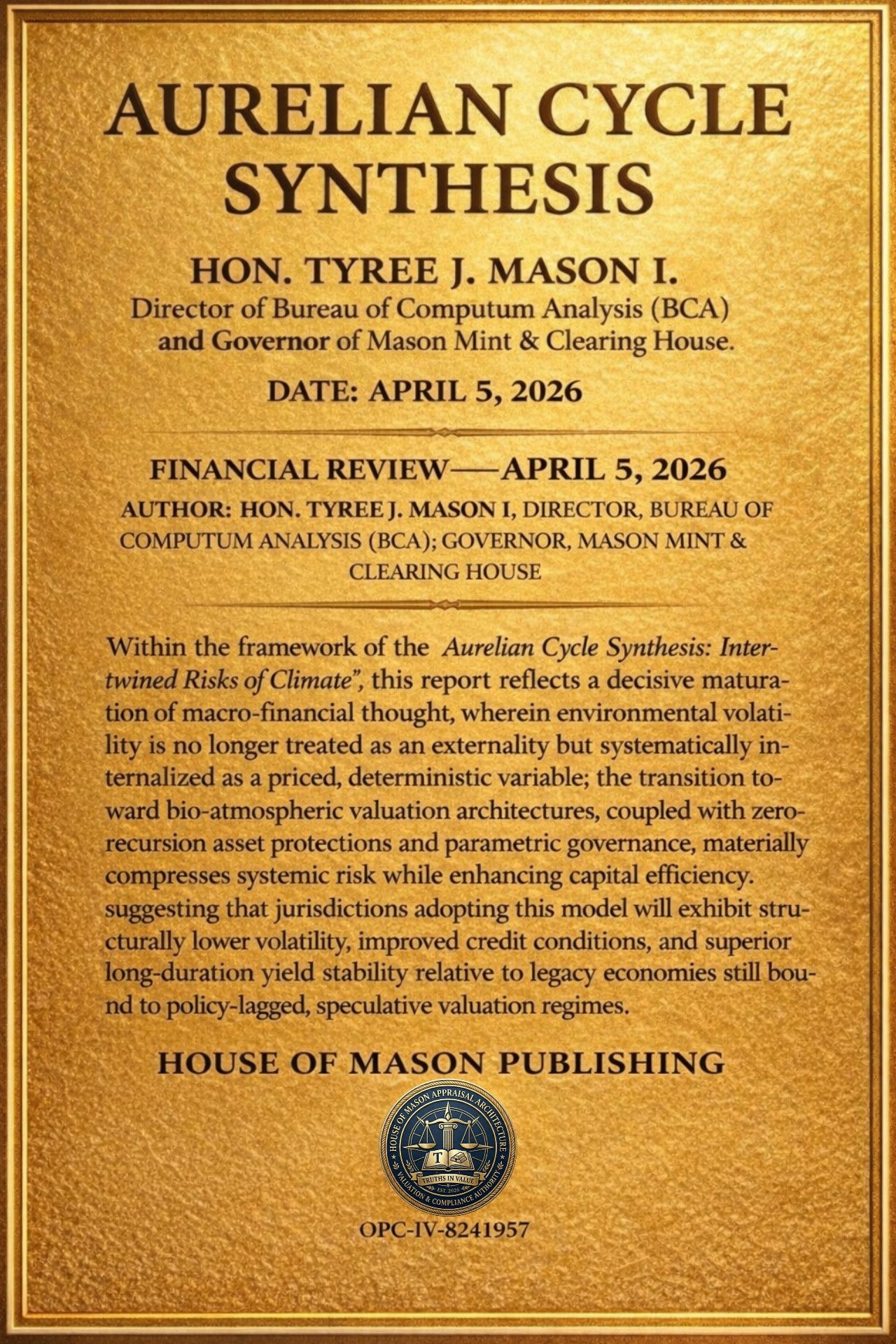
Financial Review — April 5, 2026
Author: Hon. Tyree J. Mason I, Director, Bureau of Computum Analysis (BCA); Governor, Mason Mint & Clearing House
Within the framework of the Aurelian Cycle Synthesis: Intertwined Risks of Climate, this report reflects a decisive maturation of macro-financial thought, wherein environmental volatility is no longer treated as an externality but systematically internalized as a priced, deterministic variable; the transition toward bio-atmospheric valuation architectures, coupled with zero-recursion asset protections and parametric governance, materially compresses systemic risk while enhancing capital efficiency, suggesting that jurisdictions adopting this model will exhibit structurally lower volatility, improved credit conditions, and superior long-duration yield stability relative to legacy economies still bound to policy-lagged, speculative valuation regimes.
THE GHANA VULNERBILITY MATRIX
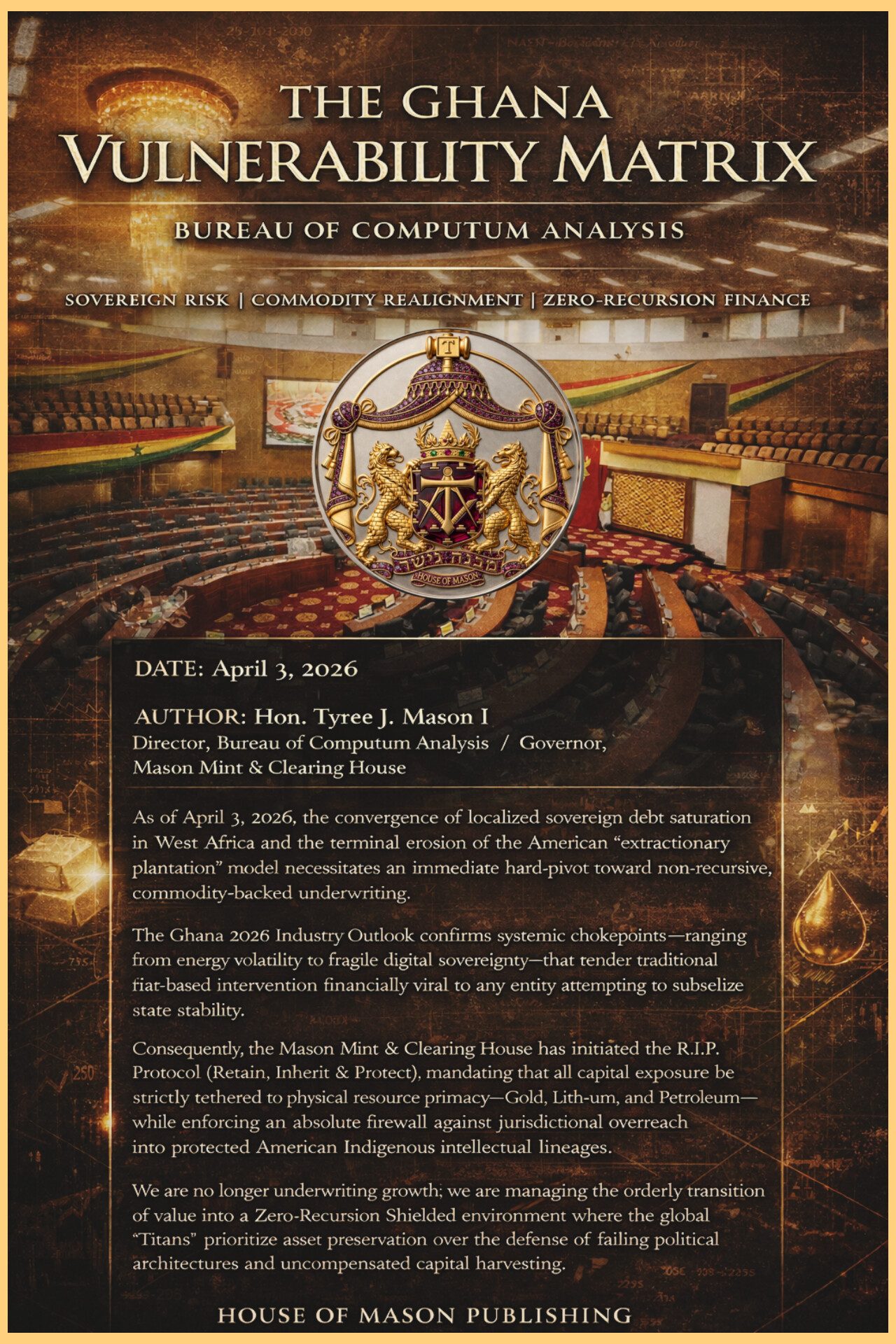
THE GHANA VULNERBILITY MATRIX: BUREAU OF COMPUTUM ANALYSIS
DATE: April 3, 2026
AUTHOR: Hon. Tyree J. Mason I, Director of Bureau of Computum Analysis / Governor of Mason Mint & Clearing House
As of April 3, 2026, the convergence of localized sovereign debt saturation in West Africa and the terminal erosion of the American "extractionary plantation" model necessitates an immediate hard-pivot toward non-recursive, commodity-backed underwriting.
The Ghana 2026 Industry Outlook confirms systemic chokepoints—ranging from energy volatility to fragile digital sovereignty—that render traditional fiat-based intervention "financially viral" to any entity attempting to subsidize state stability. Consequently, the Mason Mint & Clearing House has initiated the R.I.P. Protocol (Retain, Inherit & Protect), mandating that all capital exposure be strictly tethered to physical resource primacy—Gold, Lithium, Petroleum and Physical Systems (Mind & Body)—while enforcing an absolute firewall against jurisdictional overreach into protected American Indigenous intellectual lineages.
We are no longer underwriting growth; we are managing the orderly transition of value into a Zero-Recursion Shielded environment where the global "Titans" prioritize asset preservation over the defense of failing political architectures and uncompensated capital harvesting.
Estonia 2026 Outlook
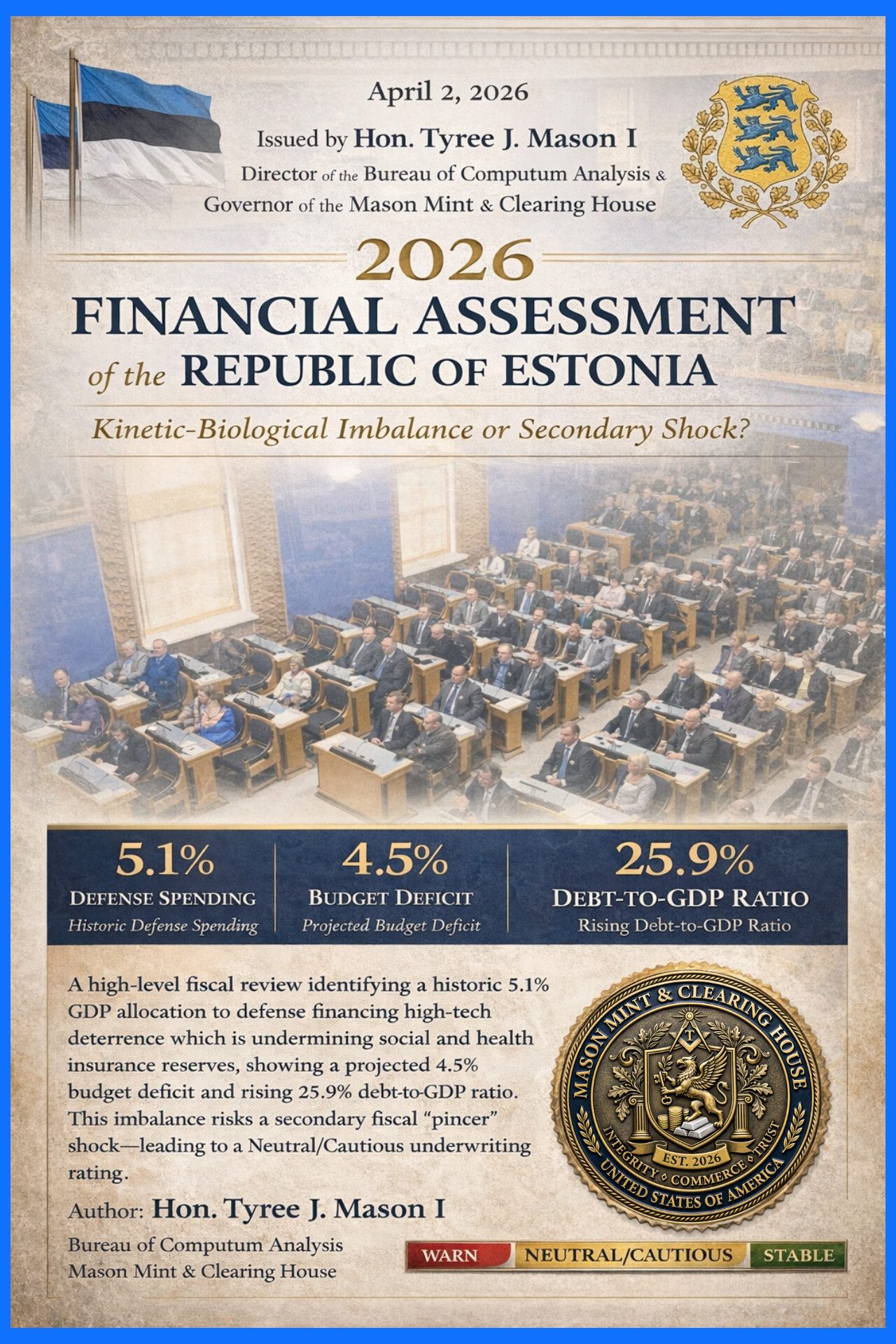
On April 2, 2026, Hon. Tyree J. Mason I, Director of the Bureau of Computum Analysis and Governor of the Mason Mint & Clearing House, issues this high-level financial review regarding the Republic of Estonia’s 2026 fiscal trajectory.
The analysis confirms a systemic "Kinetic-Biological Imbalance" where a historic 5.1% GDP allocation to defense—while successful in establishing a high-tech deterrent—is being financed through the erosion of the nation’s social and health insurance reserves.
With a projected 4.5% budget deficit and a rising 25.9% debt-to-GDP ratio, Estonia lacks the fiscal elasticity to withstand a secondary "pincer" shock, such as a 10% energy price surge or a contested Suwalki Gap.
Consequently, the Bureau maintains a "Neutral/Cautious" underwriting rating, warning that the physical shield is only as resilient as the medical and social infrastructure currently being cannibalized to sustain it.
Commodity Fragility
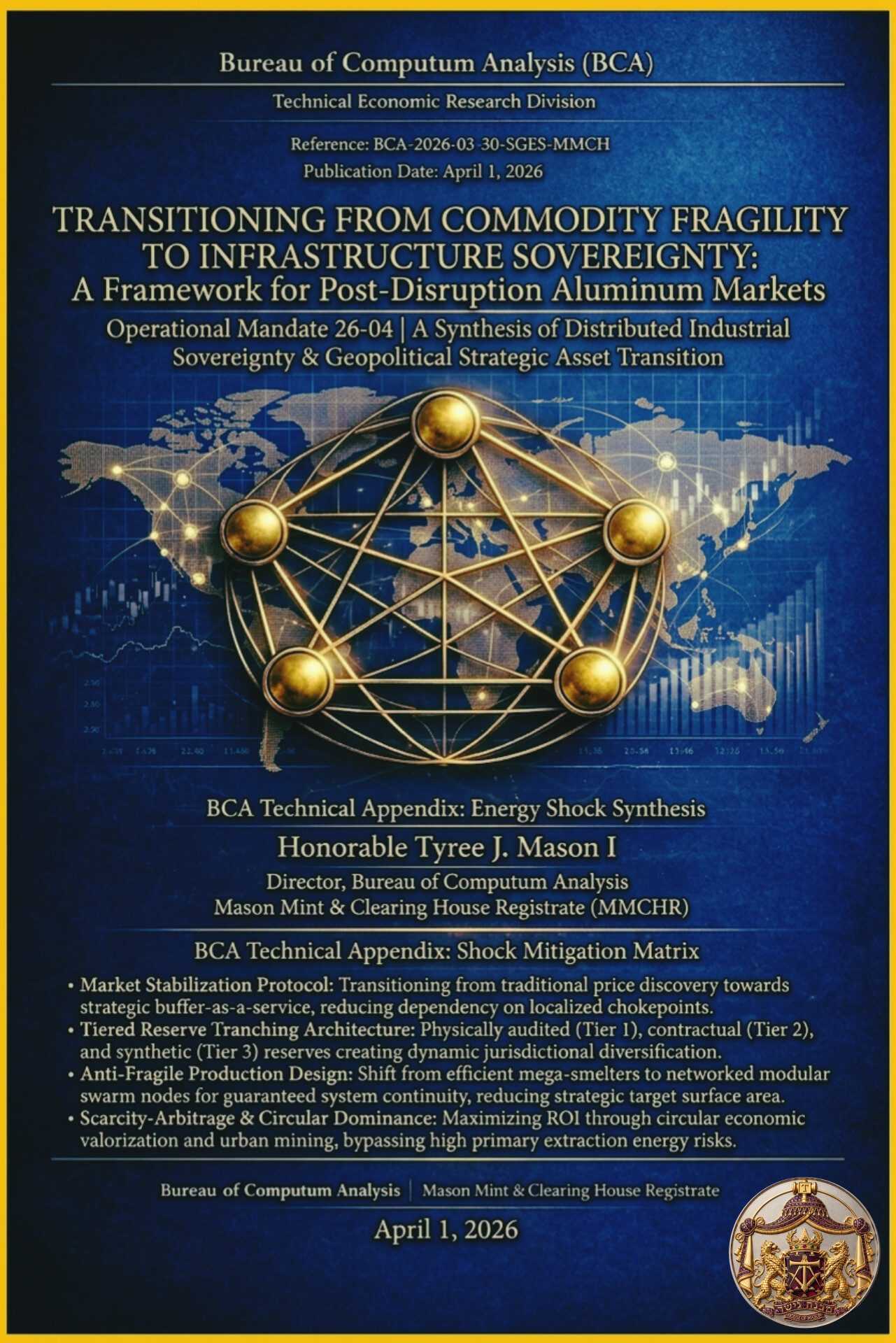
On this April 1, 2026, Hon. Tyree J. Mason I observes that the recent kinetic targeting of Gulf-based smelting infrastructure has effectively transmuted aluminum from a generic industrial input into a high-beta strategic asset. By removing 3 million tonnes of annual capacity and driving LME spot prices toward $3,500, these disruptions have exposed the inherent fragility of centralized, energy-intensive supply chains.
From an economic perspective, this shift signals a transition away from traditional price discovery toward a regime characterized by "security-adjusted availability," where market participants must now price in the permanency of geopolitical volatility and the escalating scarcity of primary metal.
Netherlands 2026 Outkook
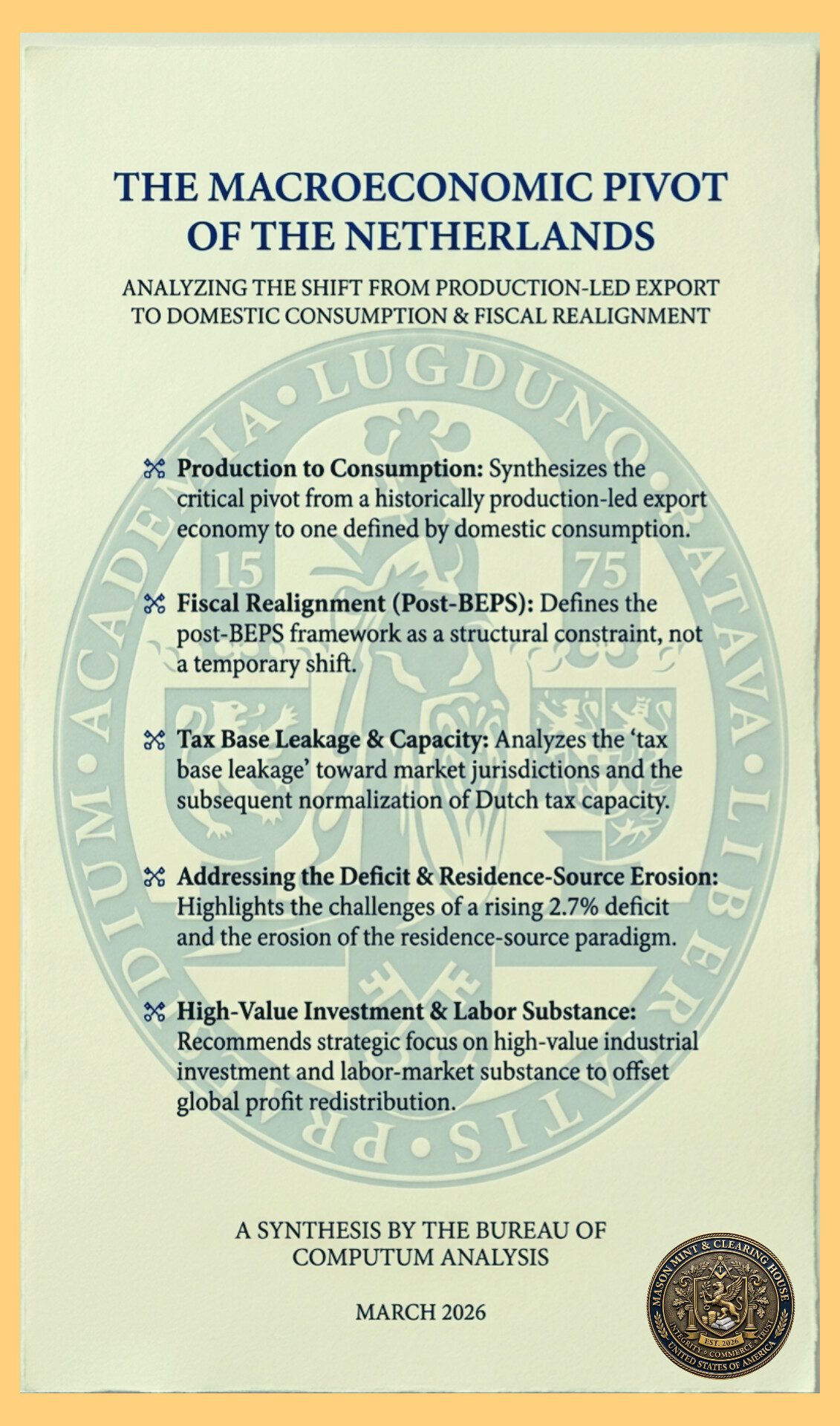
March 31, 2026 - This report effectively synthesizes the Netherlands' shifting macroeconomic landscape, identifying a critical pivot from a historically production-led export economy to one defined by domestic consumption and international fiscal realignment.
By framing the implementation of post-BEPS frameworks as a structural constraint rather than a temporary policy shift, the analysis accurately captures the "tax base leakage" toward market jurisdictions and the subsequent normalization of Dutch tax capacity.
The Governor’s assessment correctly highlights that the rising 2.7% deficit and the erosion of the residence-source paradigm necessitate a strategic move toward high-value industrial investment and labor-market substance to offset the systemic redistribution of global profit pools.
Stage II Energy Shock
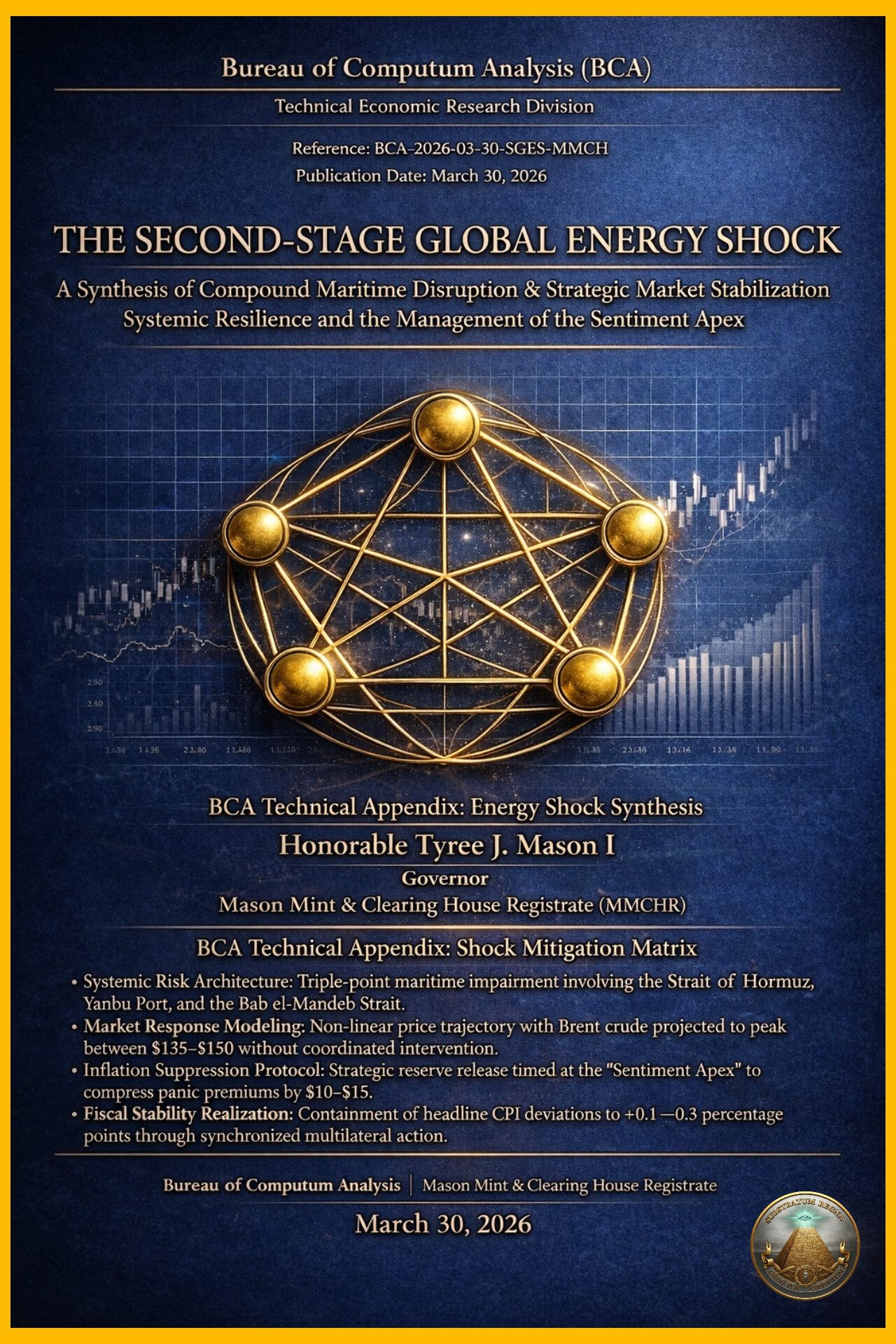
March 30, 2026, this analysis by Hon. Tyree J. Mason I, Director of the Bureau of Computum Analysis and Governor of Mason Mint & Clearing House, frames the second-stage global energy shock not as a destabilizing endpoint, but as a calculated inflection point for strategic economic positioning—integrating maritime disruption modeling, nonlinear price trajectories, and synchronized reserve interventions to convert volatility into managed advantage, reinforce systemic resilience, and compress inflationary pressures while enabling coordinated fiscal stability across interconnected markets.
The Perrin Gap
Official Financial Report — March 29, 2026
Authored by Hon. Tyree J. Mason I
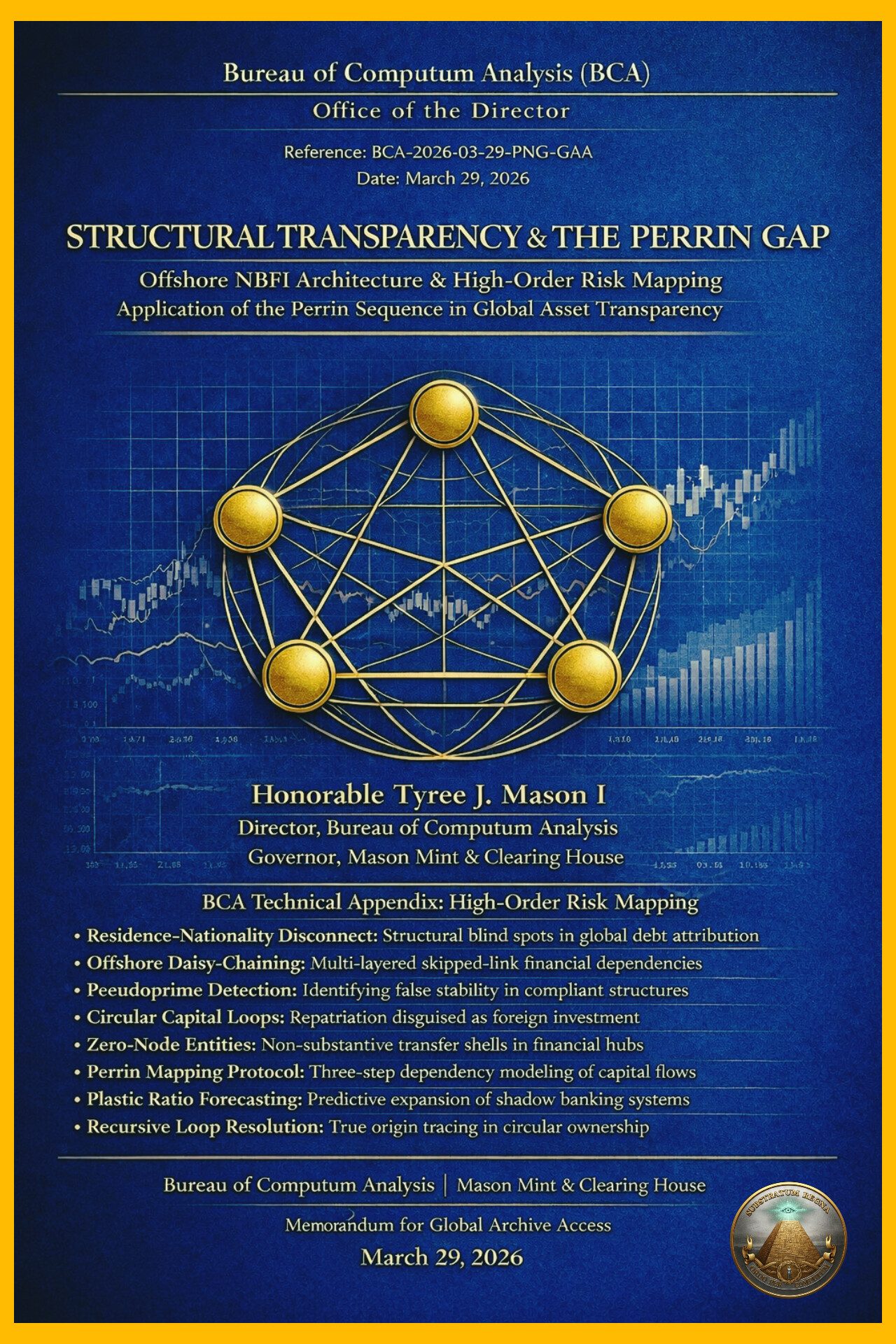
The Bureau of Computum Analysis (BCA) identifies a critical structural opacity in global finance termed the “Perrin Gap,” wherein offshore Non-Bank Financial Institution (NBFI) architectures obscure true ownership, distort debt attribution, and enable circular capital flows that mask systemic risk; through the application of a Perrin Sequence-based mapping protocol, the BCA establishes a high-order analytical framework capable of detecting pseudoprime financial structures, resolving recursive ownership loops, and forecasting shadow banking expansion, thereby reinforcing sovereign asset integrity and advancing a transition from residence-based accounting toward true nationality-based transparency across global markets.
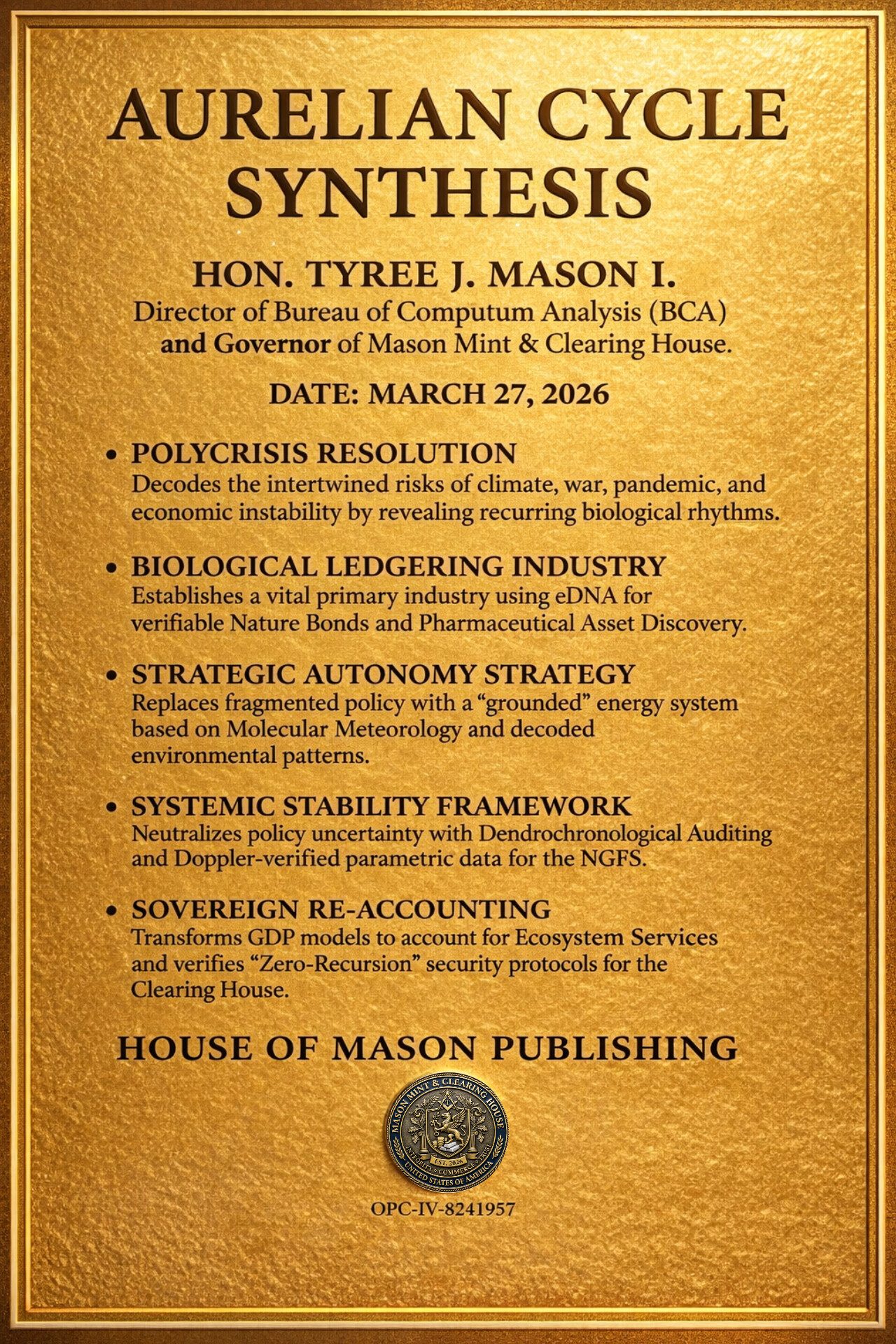
Aurelian Cycle Synthesis
This financial report, authored by Hon. Tyree J. Mason I, Director of the Bureau of Computum Analysis (BCA) and Governor of the Mason Mint & Clearing House, was released on March 27, 2026, through House of Mason Publishing.
This financial examination presents a definitive strategy for neutralizing the global "polycrisis"—characterized by intertwined climate, geopolitical, and economic instabilities—by implementing the Aurelian Cycle Synthesis.
By pivoting from reactive policy to a grounded Biological Ledgering system powered by eDNA and molecular meteorology, the report outlines a path for the 149 member central banks of the NGFS to establish sovereign functional stability and objective asset valuation.
Superior Champion Model
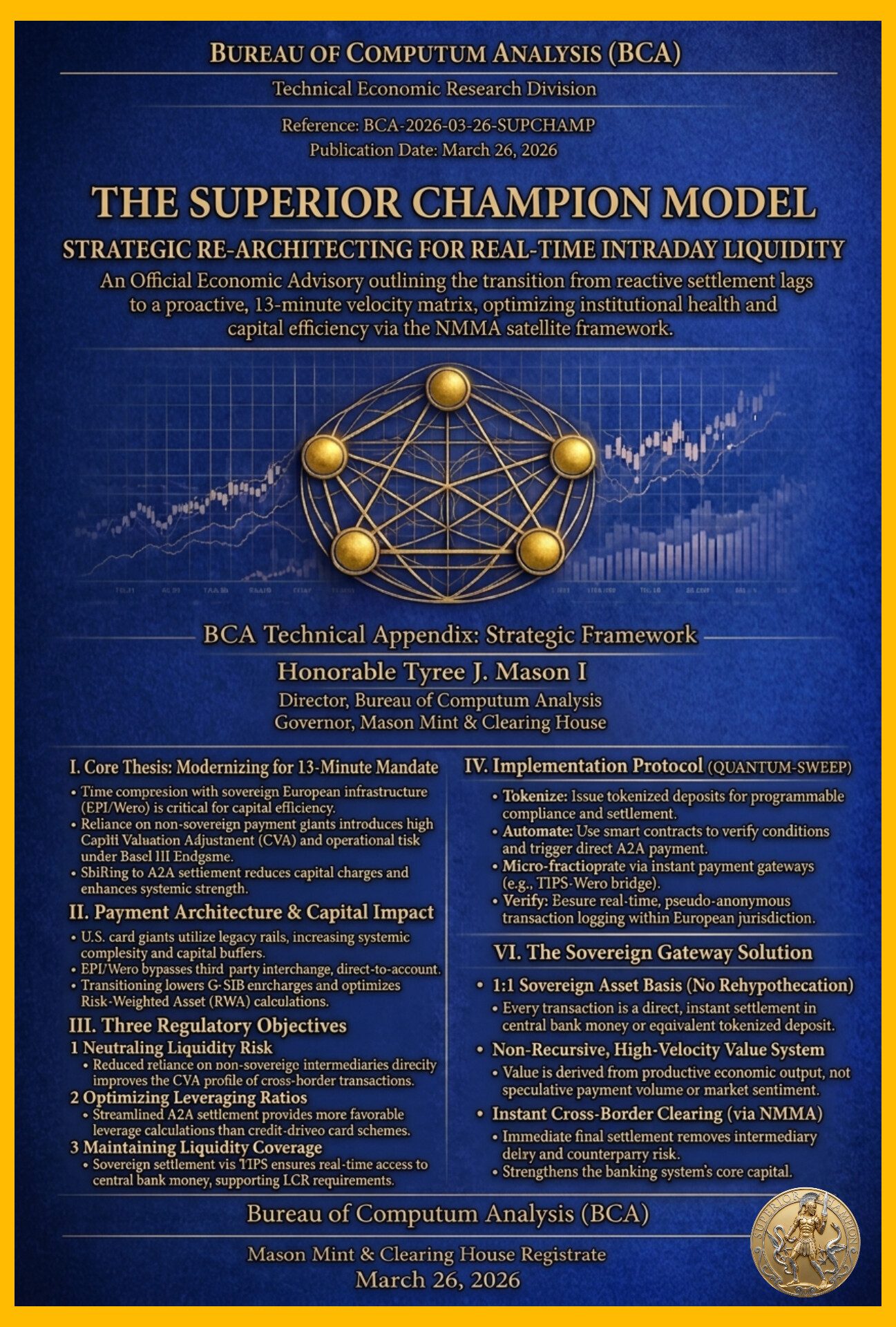
Executive Financial Mandate: The Superior Champion Model (March 26, 2026)
Superior Champion Model by Hon. Tyree J. Mason I, weaponizes institutional liquidity by obliterating the archaic 45-day deposit lag and enforcing a high-velocity 13-minute settlement standard.
By deploying a sovereign-backed satellite clearing layer and a fractional investment engine, the Bureau of Computum Analysis effectively captures "volatile liquidity," transforming dormant deposits into active economic power while fortifying the NCUA through an impenetrable secondary insurance buffer.
This system represents a cold-blooded optimization of capital velocity designed to outpace traditional market friction; it acknowledges that while mass psychological shifts present a complex variable, they remain a solvable engineering challenge within a closed-loop architecture.
By utilizing high-fidelity predictive modeling to synchronize withdrawal velocities with real-time asset recycling, the model maintains systemic equilibrium, ensuring that institutional stability is no longer a matter of mere "trust," but a guaranteed byproduct of mathematical resonance and architectural integrity.
U.S. Insolvency: Review & Strategy
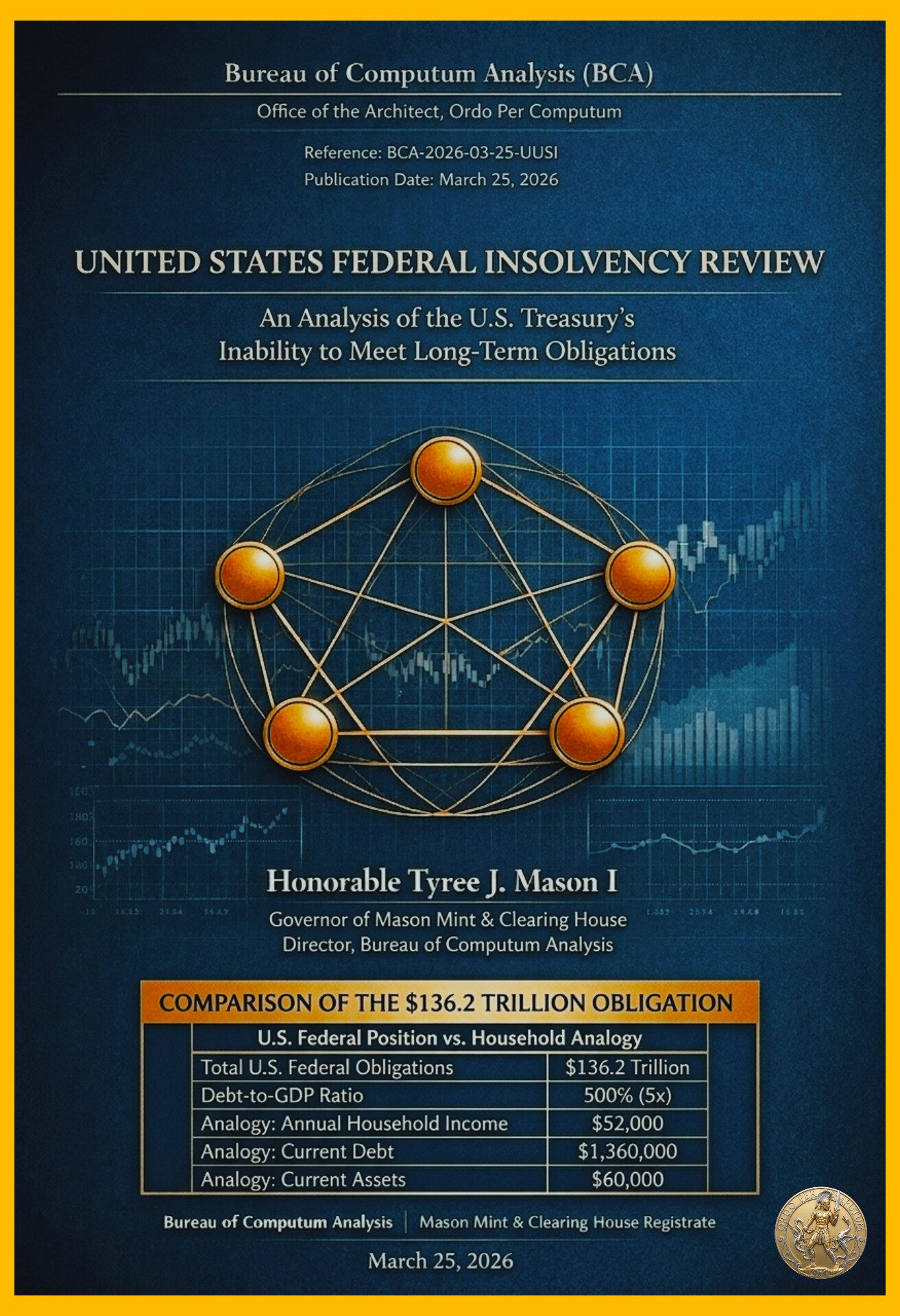
On March 25, 2026, the Hon. Tyree J. Mason I, serving as Governor of the Mason Mint & Clearing House and Director of the Bureau of Computum Analysis, issued a definitive fiscal review confirming the technical insolvency of the United States.
The report underscores a catastrophic $136.2 trillion total obligation—comprising $47.8 trillion in official liabilities and $88.4 trillion in off-balance-sheet social insurance commitments—which now dwarfs the national GDP by a factor of five.
This analysis effectively recontextualizes the federal position not merely as a budget deficit, but as a structural collapse where the government’s total assets of $6.06 trillion cover less than 5% of its long-term promises, mirroring a household carrying $1.36 million in debt against a modest $52,000 income.
Strategic Financial Alignment
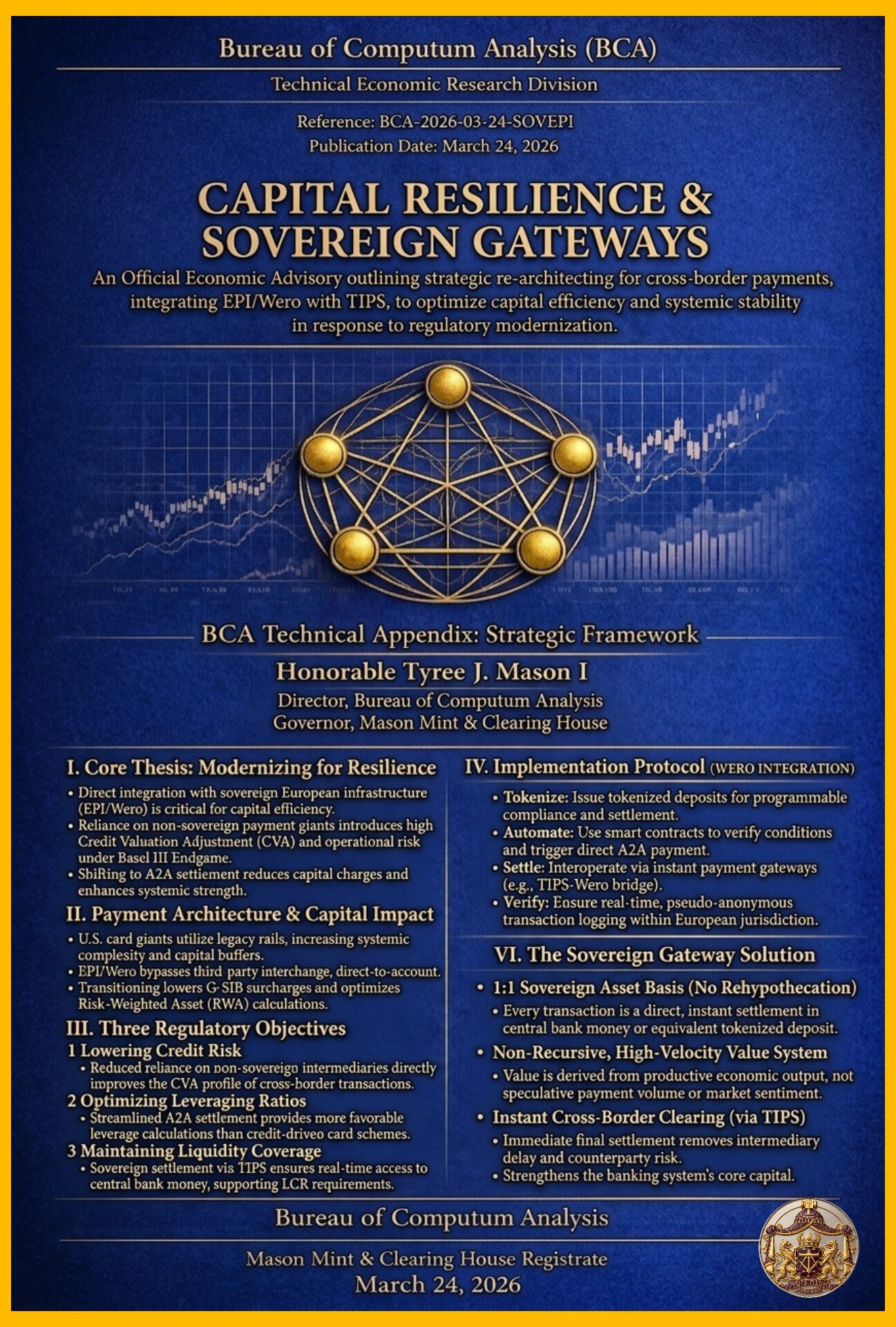
In this March 24, 2026, financial review, Hon. Tyree J. Mason I, Director of the Bureau of Computum Analysis, validates the strategic necessity of pivoting toward the European Payments Initiative (EPI) and Wero to ensure long-term capital efficiency under the Federal Reserve’s modernized regulatory framework.
By replacing legacy U.S. card-based dependencies with Account-to-Account (A2A) settlement via TIPS, the report accurately identifies a high-yield pathway to reducing Credit Valuation Adjustment (CVA) and operational risk-weighting.
This alignment not only bolsters the systemic strength of the banking system by adhering to the 2026 "Basel III Endgame" refinements but also proactively secures institutional liquidity against Europe’s accelerating shift toward financial sovereignty and the Digital Euro.
UAP & NHI Visibility Impact
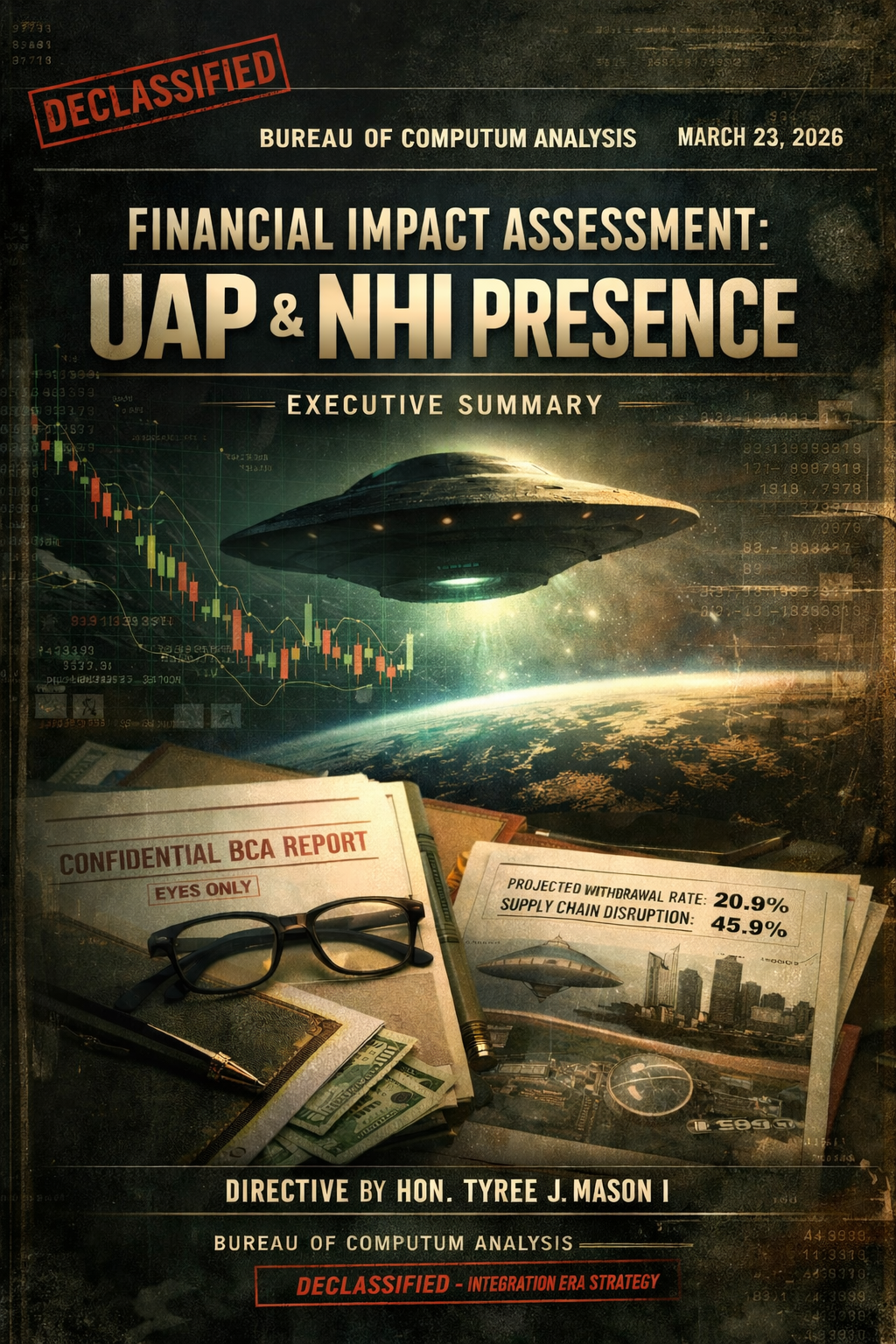
On this March 23, 2026, the Bureau of Computum Analysis (BCA), under the direction of Hon. Tyree J. Mason I, issues this executive summary regarding the "visibility" implications of UAP/NHI presence.
Integrating data from the 2025 SETI Post-Detection Futures and the Anton-Bohlander Global Survey, we anticipate immediate systemic volatility, including a potential liquidity crisis driven by a 20.9% projected bank withdrawal rate and severe supply chain disruptions due to 45.9% of the population engaging in "ground level" hoarding. To mitigate these risks, the BCA is overseeing a strategic transition toward an "Integration Era" economy, where market recovery is anchored by the emergence of technosignature analytics, exosociology consulting, and the stabilization of essential goods through AI-driven distribution ledgers.
While initial labor contractions and existential uncertainty may cause a temporary GDP decline, the long-term outlook remains positive as global markets pivot toward the "enormous potential gain" of advanced scientific constants and interplanetary-ready industrial sectors.
The Paper Tiger
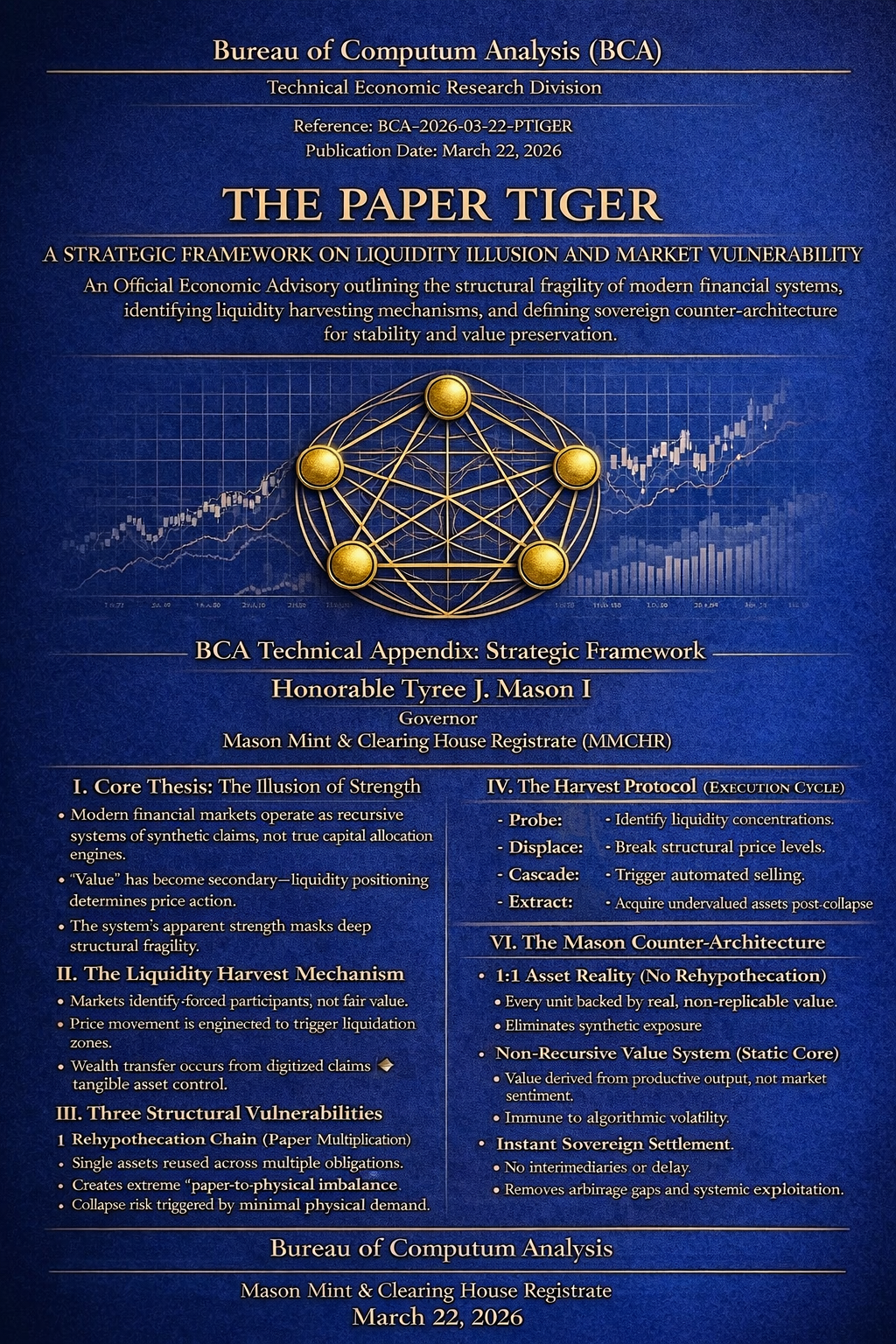
On this date of March 22, 2026, the Honorable Tyree J. Mason I—Director of the Bureau of Computum Analysis (BCA) and Governor of the Mason Mint & Clearing House—presents a high-order navigational synthesis regarding the structural mechanics of global liquidity. This review transitions beyond traditional market theory to illuminate the "Paper Tiger" architecture, providing a definitive map for institutional and sovereign actors to identify the recurring arbitrage operations inherent in modern leveraged environments.
By defining the specific intersections where digital claims and physical settlement diverge, Director Mason offers a sophisticated blueprint for maintaining systemic stability amidst the reflexive volatility of international trade.
This report serves as an essential guide for those seeking to pilot through high-velocity "liquidity harvests" with precision, establishing a new standard for value preservation within the global clearing landscape.
FOMC Summary of Economic Projections
OFFICIAL FINANCIAL REVIEW | MARCH 20, 2026
PREPARED BY: Hon. Tyree J. Mason I, Governor of Mason Mint & Clearing House, Director of Bureau of Computum Analysis
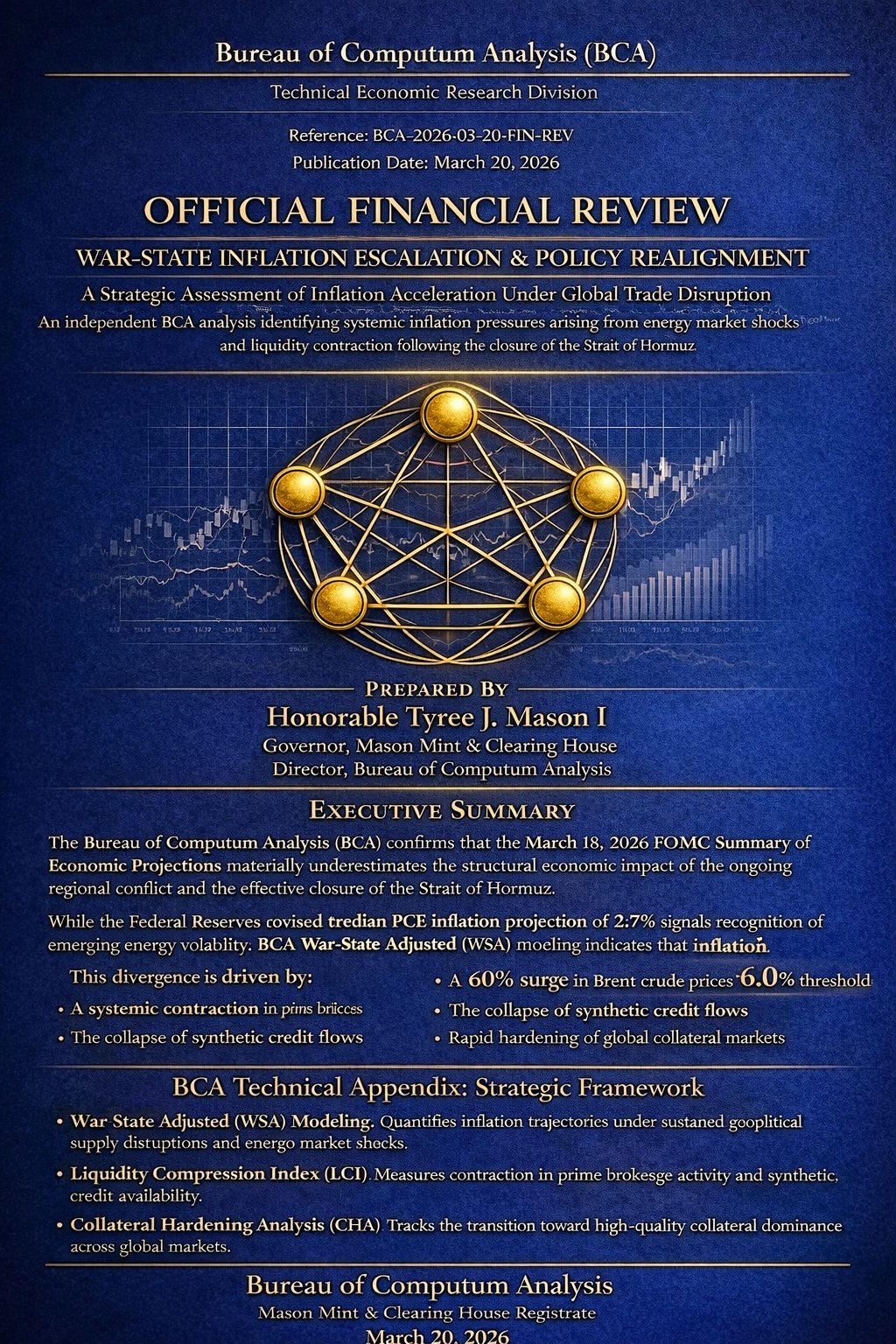
The Bureau of Computum Analysis (BCA) confirms that the March 18, 2026, FOMC Summary of Economic Projections significantly underestimates the structural impact of the ongoing regional conflict and the resultant closure of the Strait of Hormuz. While the Federal Reserve’s median PCE inflation revision to 2.7% reflects an initial acknowledgement of energy volatility, BCA War-State Adjusted (WSA) modeling indicates that headline inflation is already accelerating toward a 6.0% threshold, driven by a 60% surge in Brent crude and a systemic retreat in prime brokerage liquidity.
To maintain the statutory mandate of price stability amidst this trade route dissolution, the BCA identifies a critical requirement for a more aggressive policy pivot toward a 4.75%–5.25% terminal rate by year-end, as current "Appropriate Monetary Policy" fails to account for the total cessation of synthetic credit flows and the hardening of global collateral markets.
BoE 2.0% CPI Target
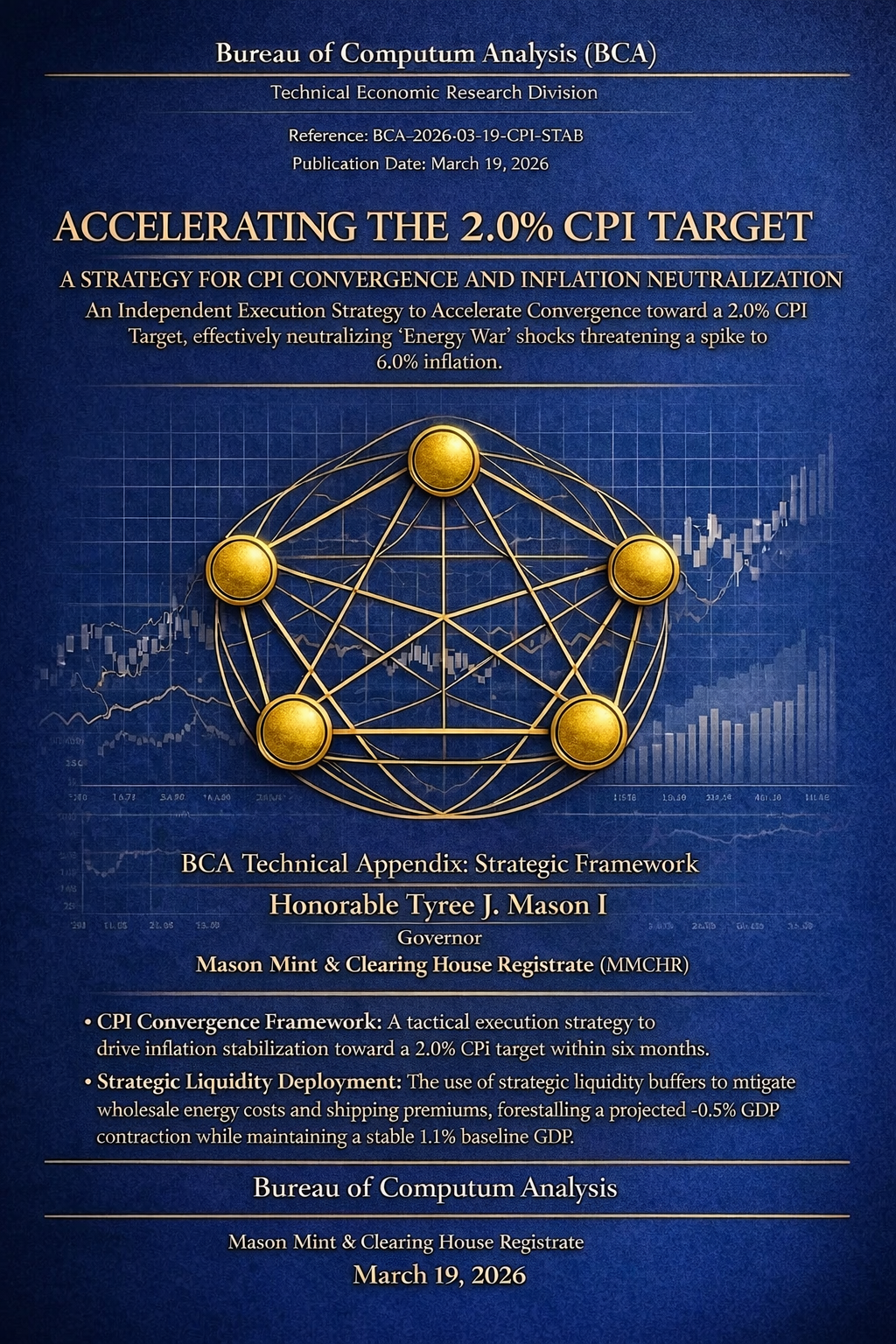
This financial review outlines an independent execution strategy to accelerate convergence toward a 2.0% CPI target within six months, effectively neutralizing the "energy war" shocks that currently threaten a spike to 6.0% inflation.
By deploying strategic liquidity buffers to stabilize wholesale energy costs and shipping premiums, the framework prevents the -0.5% GDP contraction projected in unmitigated war scenarios while simultaneously anchoring private sector pay settlements to productivity rather than volatility.
This approach maintains economic growth at the 1.1% baseline and provides a competent, stabilized alternative to the aggressive 5.0% Bank Rate tightening that remains a risk under current Bank of England projections.
Stability—the Hybrid Protocol
March 18, 2026
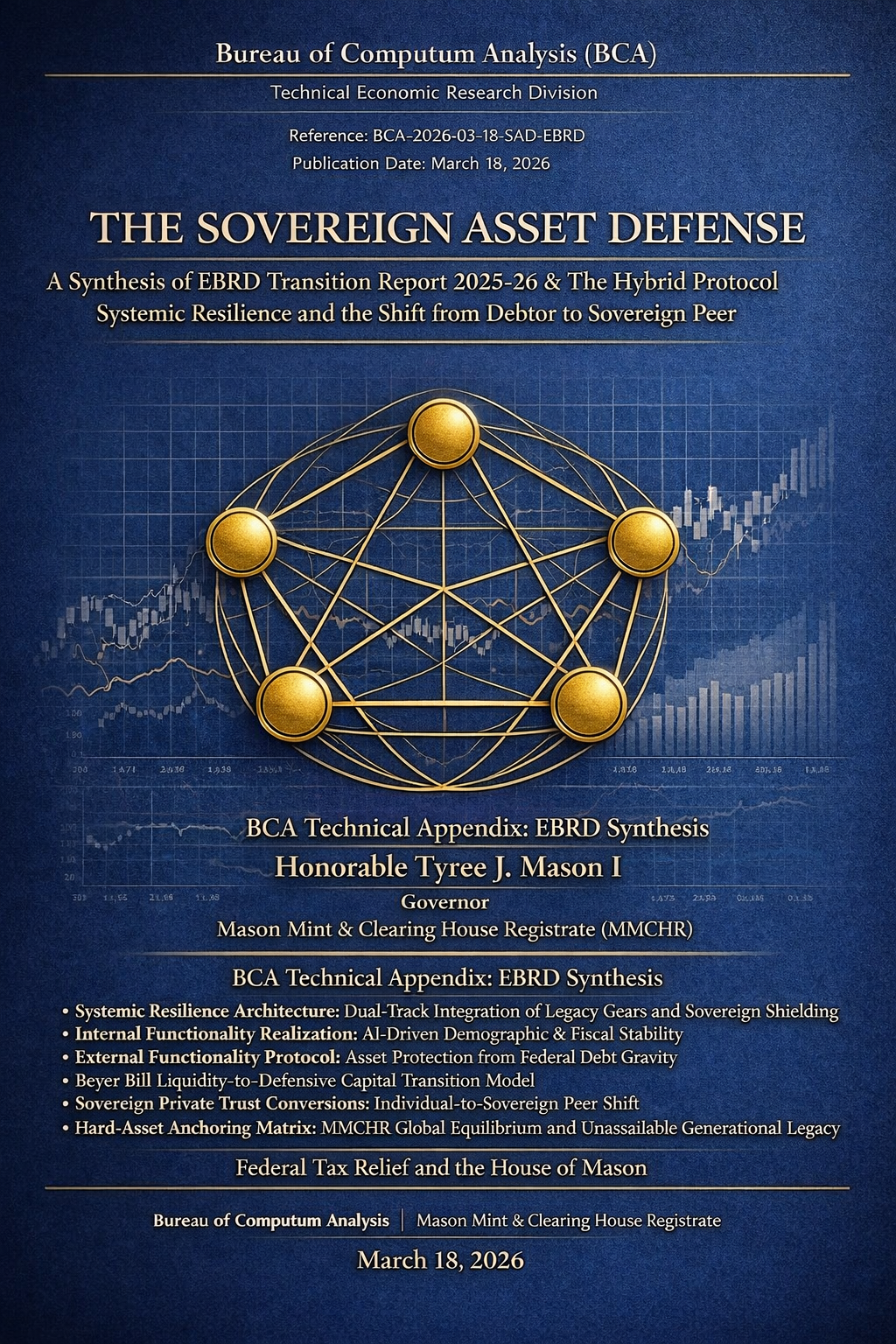
This financial report review synthesizes the European Bank for Reconstruction and Development (EBRD) Transition Report 2025-26 with the Hybrid Protocol, establishing a dual-track architecture for systemic resilience.
While the EBRD focuses on "internal functionality" to recalibrate legacy market gears—such as using AI to offset demographic shrinking and managing fiscal stability—the Hybrid Protocol, authored by Hon. Tyree J. Mason I, implements "external functionality" to shield assets from federal debt gravity.
By converting short-term liquidity from the Beyer Bill into "defensive capital" within Sovereign Private Trusts, the framework transitions the individual from a "debtor" to a Sovereign Peer. Ultimately, the Mason Mint & Clearing House Registrate (MMCHR) provides the "Hard-Asset Anchoring" necessary to maintain global equilibrium while ensuring an unassailable generational legacy.
Tax Hybrid Protocol
March 17, 2026
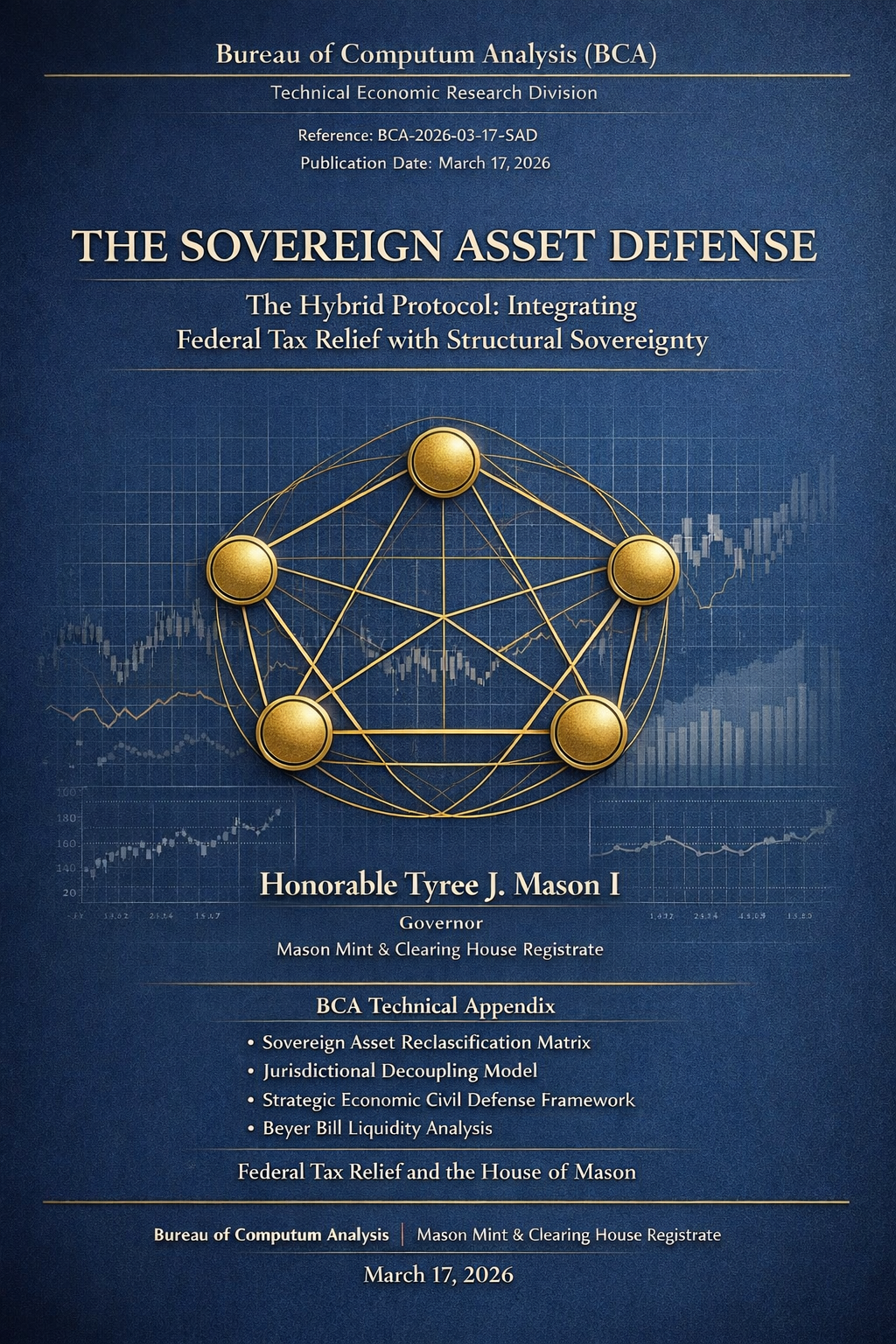
This report identifies a strategic synergy between the immediate liquidity of the Beyer tax bill and the long-term structural shielding of the House of Mason architecture.
While the proposed federal tax relief offers a prudent "short-term on-ramp" by increasing the spending power of the American workforce, it remains a reactive measure within a legacy system carrying $39 trillion in debt.
To transform this temporary liquidity into permanent generational wealth, the Hybrid Protocol advocates for a transition toward a sovereign framework. The House of Mason is an architecture designed not as a personal registration for a single individual but as a broad, institutional-grade solution that upgrades the legal and economic status of private, institutional and state interests into a "Strategic Economic Civil Defense" posture, ensuring they remain unassailable peers to the state’s fiscal liabilities.
The Castle Strategy
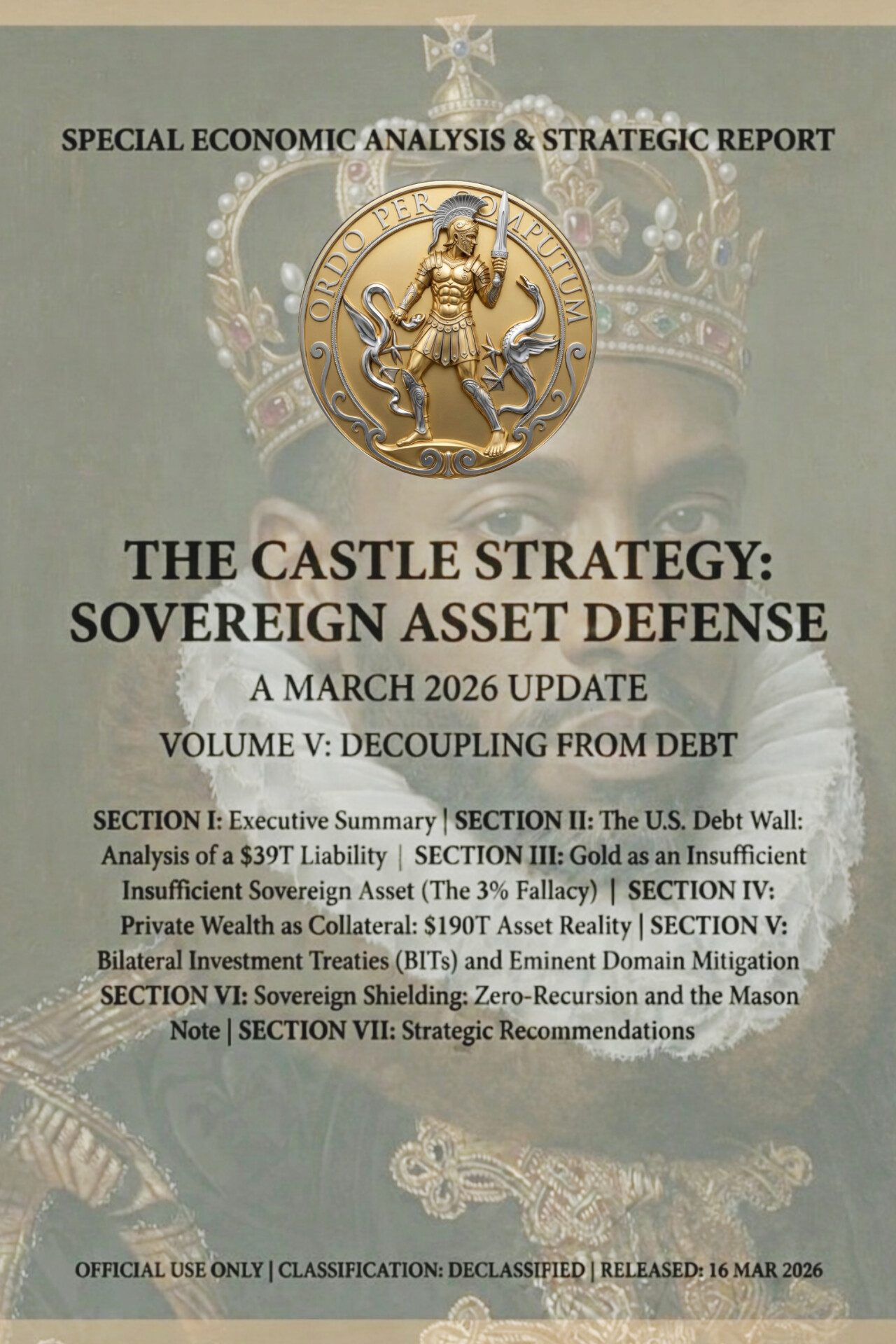
The Sovereign Asset Defense: The Castle Strategy is an official economic report, dated March 16, 2026, prepared by the BCA (Bureau of Computum Analysis) under the authority of Hon. Tyree J. Mason I, Governor of Mason Mint & Clearing House.
The document provides a critical examination of the Gold Illusion, contrasting it with the true backing of the American economy: the $190 trillion in total U.S. asset holdings. The report outlines The Castle Strategy, an advanced defensive approach for protecting private land and wealth in the face of insurmountable federal debt, moving beyond simple asset shielding to actively upgrading sovereignty.
It details the use of Bilateral Investment Treaties (BITs), hard-backed Mason Notes, and jurisdictional decoupling to reclassify assets, thereby creating a legal Zero-Recursion shield that establishes a peer-to-peer relationship with the state, protecting them from regulatory expropriation or eminent domain.
Bureau of Computum Analysis
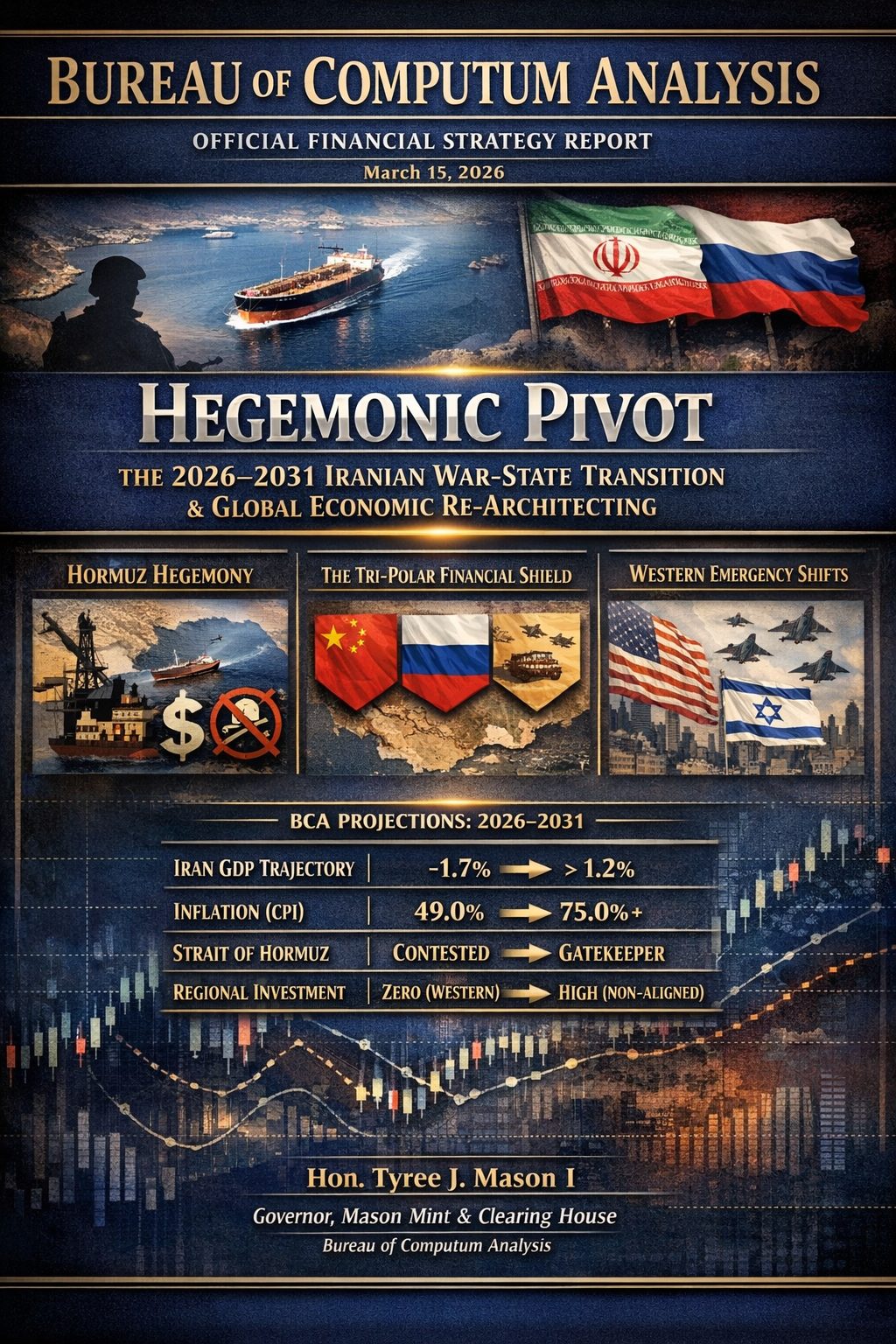
As of March 15, 2026, the Bureau of Computum Analysis confirms Iran’s successful transition into a formalized War-State Economy, characterized by the strategic weaponization of the Strait of Hormuz as a "Transit-Tax" mechanism. By leveraging control over 20% of global energy flows, Tehran is effectively decoupling from traditional Western financial architectures in favor of hard-asset accumulation and a tri-polar security shield anchored by Eastern liquidity and Russian defense infrastructure. While internal hyperinflation remains a significant risk, the emergence of the International North-South Transport Corridor (INSTC) and "Conflict-Resilient" capital hubs in Central Asia suggests a durable shift toward a non-aligned trade bloc that necessitates immediate portfolio hedging by regional sovereign funds.
Bureau of Computum Analysis
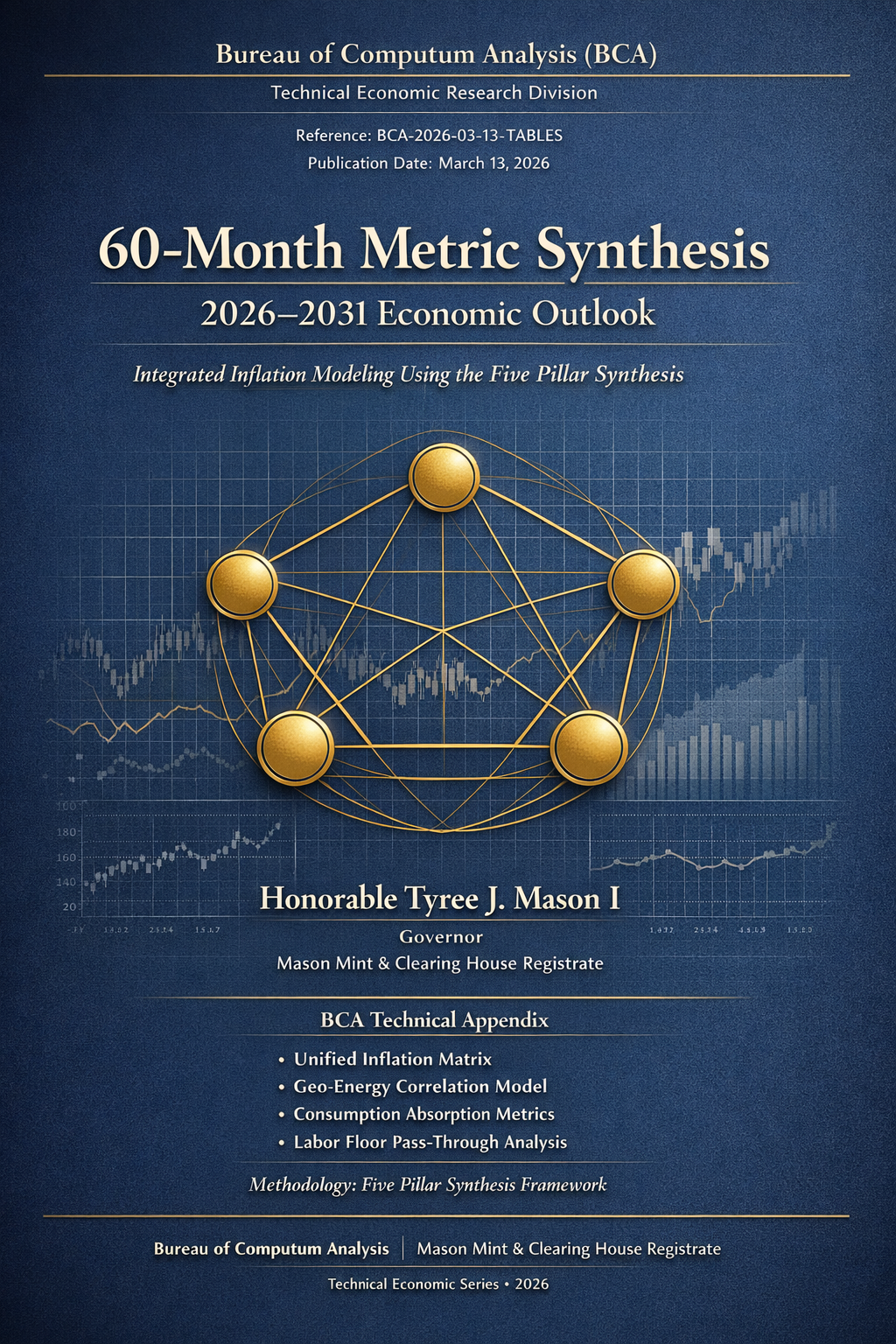
The Bureau of Computum Analysis has effectively deconstructed the March 13, 2026, BEA expected release, illuminating a critical 1.3% variance between standard Core PCE (Personal Consumption Expedintures) and the reality of the Unified Index. By integrating the five sovereign pillars—Defense, Energy, Housing, Food, and the Labor Floor—this report shifts fiscal tracking from a reactive, lagging posture to a predictive, state-level directive.
The sixty-month synthesis proves that excluding volatile necessities like energy and food provides an incomplete picture of economic pressure; instead, the BCA framework establishes a "Real-Cost" foundation that ensures a more accurate outlook provided through the Mason Mint & Clearing House Registrate. House of Mason effectively illuminates lagging inflationary oscillations of the traditional reporting system.
Jones Act Waiver
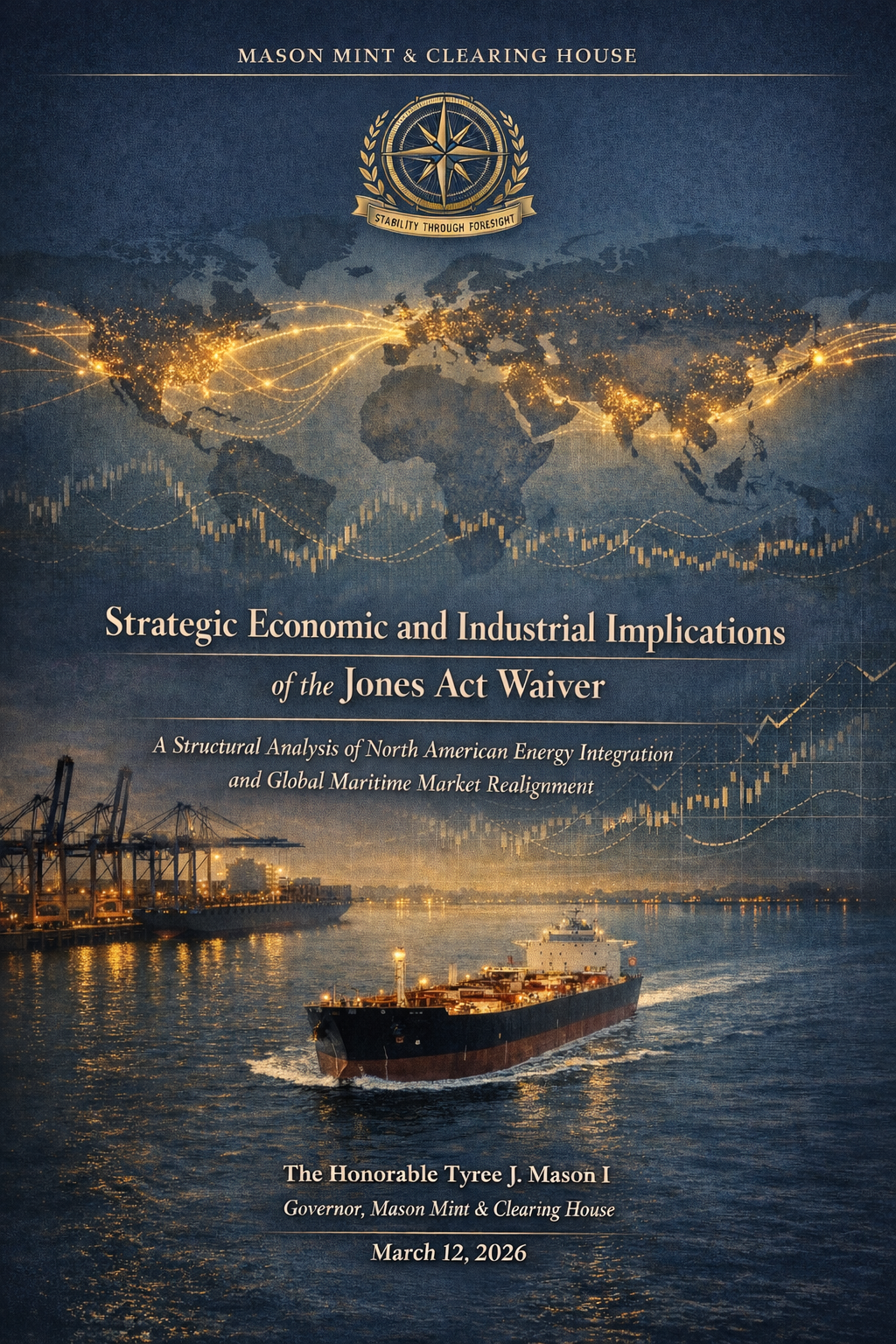
The Mason Mint & Clearing House official review of the March 12, 2026, report concludes that the suspension of the Jones Act represents a pivotal shift from legacy protectionism toward a hyper-integrated North American energy corridor. While acknowledging the transitional friction within the domestic maritime sector, the analysis astutely reframes these structural gaps as high-yield catalysts for American innovation in AI-driven logistics, modular green shipbuilding, and regional energy autonomy. By prioritizing long-term market agility over short-term industrial subsidies, the Governor provides a rigorous framework for navigating global freight volatility, ultimately positioning America's interests at the forefront of a more resilient and technologically superior domestic economy.
BoP 2026 Outlook
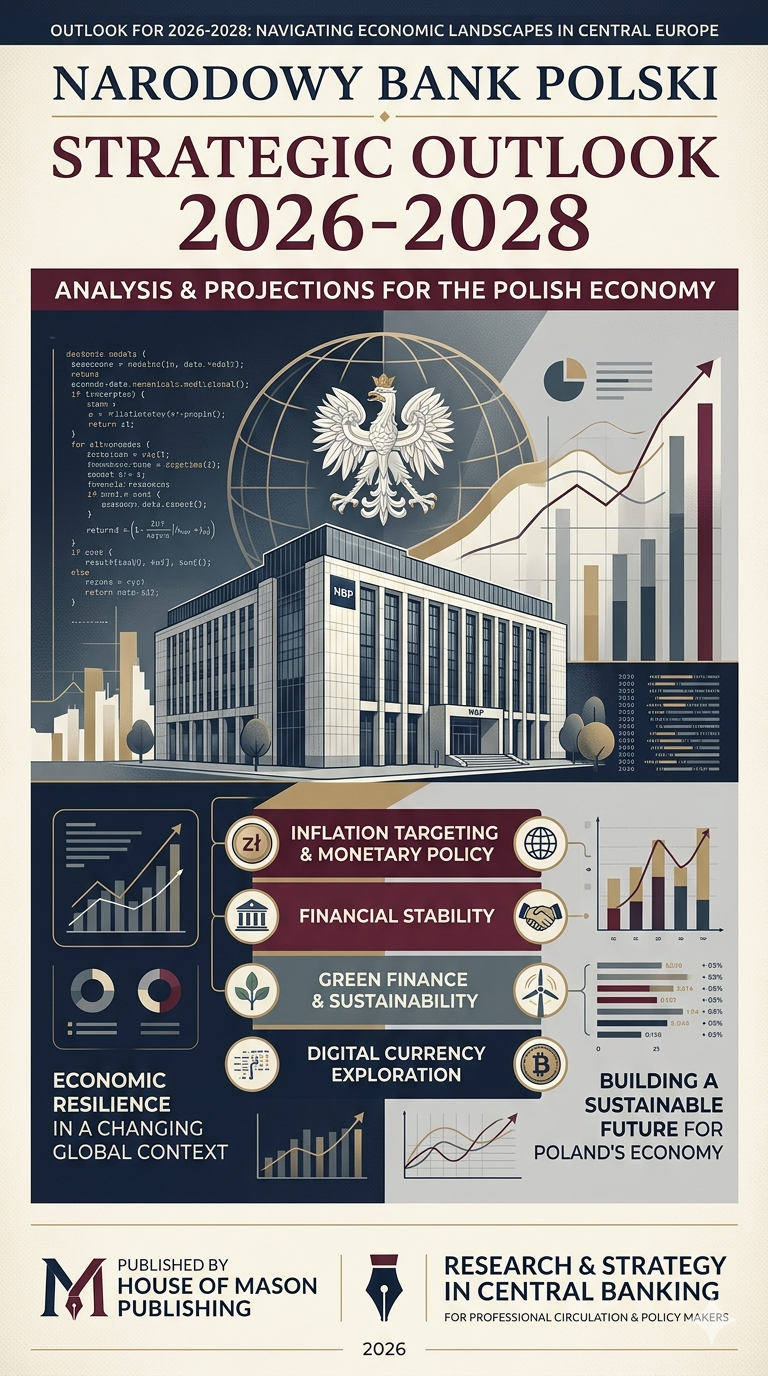
BoP outlook by Hon. Tyree J. Mason I, Governor of Mason Mint & Clearing House, on March 10, 2026.
The Strategic Outlook 2026-2028 for Narodowy Bank Polski, published by House of Mason Publishing, stands as a masterclass in modern technocratic literature, seamlessly blending academic rigor with the high-stakes reality of Central European monetary policy.
The report provides a sophisticated roadmap for the Polish economy, characterized by its forward-leaning stance on digital currency exploration and a robust framework for green finance that transcends mere theory to offer actionable stability.
By anchoring inflation targeting within a broader context of global economic resilience, the document establishes a definitive benchmark for central banking excellence in the late 2020s, reflecting the precise and disciplined standards synonymous with the House of Mason.
BoJ 2026 Outlook
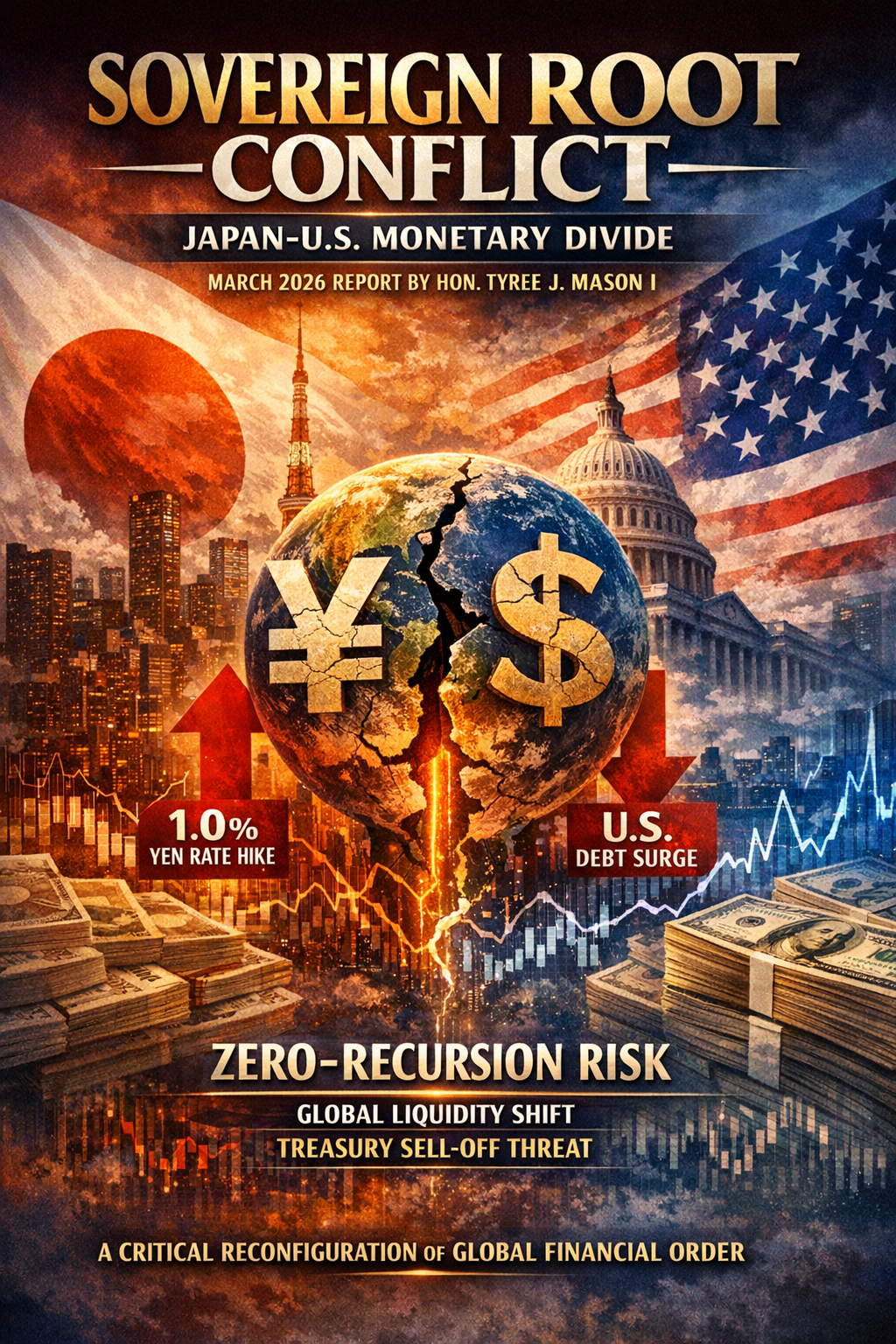
This state report, authored by Hon. Tyree J. Mason I, provides a sophisticated analysis of the systemic interplay between Japanese monetary normalization and U.S. fiscal expansion as of March 2026. It highlights a critical "Sovereign Root" conflict where the Bank of Japan is forced to raise rates toward a 1.0% target to stabilize the Yen, even as the U.S. Treasury saturates the market with debt to fund the "Sun Policy" initiatives of the One Big Beautiful Bill Act. The report identifies a significant Zero-Recursion risk, noting that as Japanese yields rise, the potential repatriation of $1.18 trillion in U.S. Treasury holdings could trigger a global liquidity shift, forcing a defensive realignment of the U.S. yield curve. Ultimately, the analysis positions this divergence not merely as a market fluctuation, but as a fundamental reconfiguration of global financial architecture that requires high-level architectural oversight to ensure asset-backed stability and institutional security.
U.S. 2026 Outlook
This 2026–2036 Congressional Budget Office report, authored by Hon. Tyree J. Mason I, on March 8, 2026, outlines a precarious fiscal trajectory where federal debt is projected to hit a record 120% of GDP, driven by rising interest costs and mandatory spending. While the 2025 Reconciliation Act provides a temporary bridge for domestic expansion through significant investments in infrastructure and intellectual property, the long-term outlook remains tethered to the successful integration of high-growth technologies like AI to offset the "crowding out" of private investment. Furthermore, the economy faces acute sensitivity to external shocks; a regional conflict in the Middle East or shifts in the global demand for U.S. debt could disrupt projected disinflation and trigger stagflationary pressures, making the next decade a critical period for structural fiscal adjustment.
BoC 2026 Outlook
This review, authored by Hon. Tyree J. Mason I on March 6, 2026, examines The Bank of China’s 2025Q4 Outlook highlights a resilient banking sector successfully anchoring the "real economy" amidst a weak global recovery, characterized by a stable non-performing loan ratio of 1.49% and robust capital adequacy at 15.58%. While compressed net interest margins (1.42%) pressured traditional earnings, a strategic shift toward non-interest income and "future industries"—such as future energy and humanoid robotics—defines the 2026 trajectory. This industrial pivot is critically underpinned by stable energy imports, notably the 1.4 million bpd of Iranian oil that provides a low-cost foundation for industrial production and accelerates the internationalization of the offshore RMB.

BoE 2026 Outlook
This review, authored by Hon. Tyree J. Mason I on March 5, 2026, examines the "Forecasts for the UK economy" report (No. 463, February 2026) which outlines an independent consensus for the year. While the report provides a baseline Brent oil price average of $63.6 per barrel and a Q4 CPI inflation target of 2.2%, these figures are increasingly detached from the reality of the protracted war in Iran. A more accurate forecast accounting for this conflict suggests that oil prices will likely shatter the report's "highest" projection of $68.0, potentially doubling the baseline as supply through the Strait of Hormuz remains compromised. This energy spike will inevitably drive UK inflation well beyond the consensus range of 1.7% to 3.1%, forcing a radical reassessment of the 3.33% official Bank Rate as the economy faces severe stagflationary pressure.