
The Castle Strategy
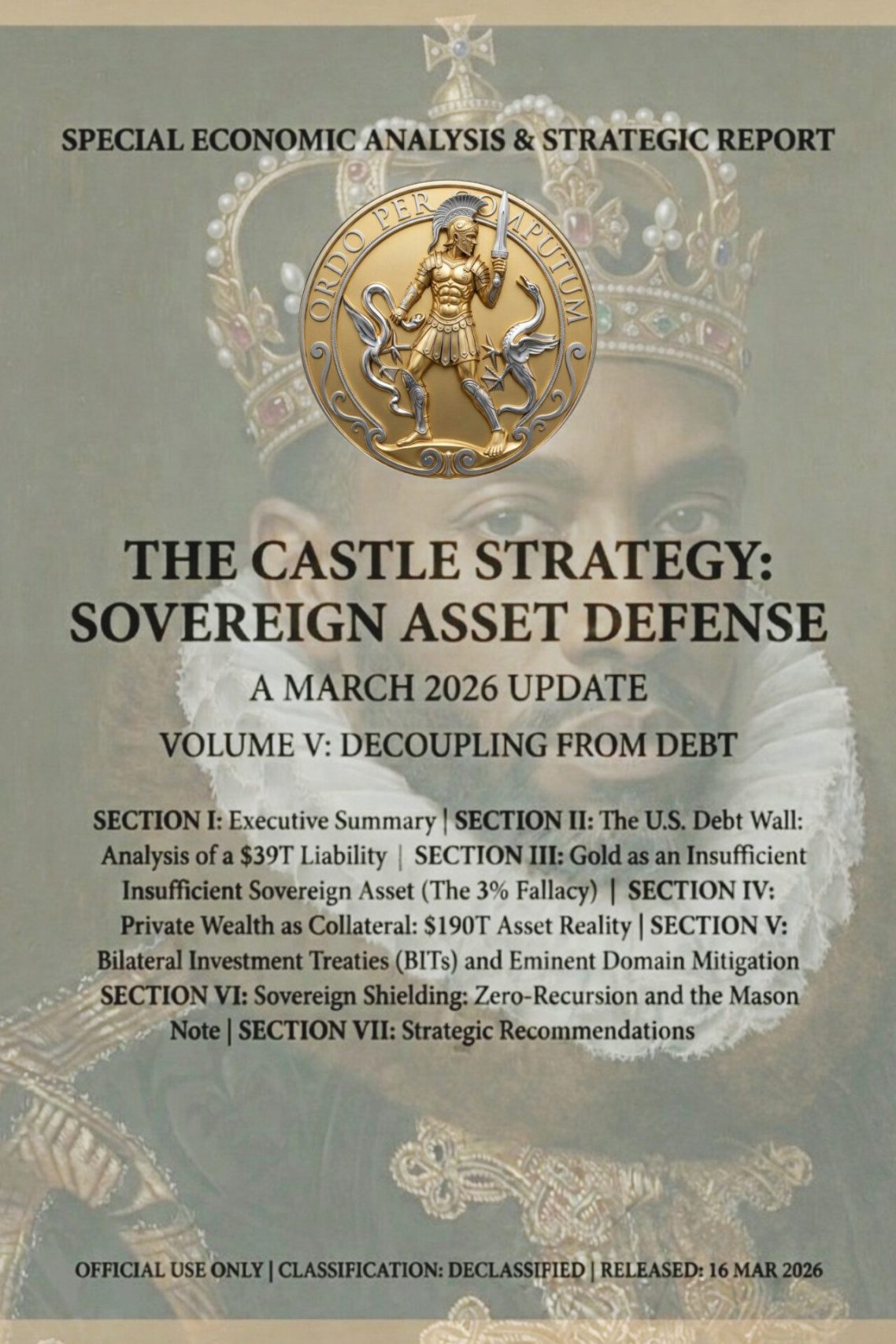
The Sovereign Asset Defense: The Castle Strategy is an official economic report, dated March 16, 2026, prepared by the BCA (Bureau of Computum Analysis) under the authority of Hon. Tyree J. Mason I, Governor of Mason Mint & Clearing House.
The document provides a critical examination of the Gold Illusion, contrasting it with the true backing of the American economy: the $190 trillion in total U.S. asset holdings. The report outlines The Castle Strategy, an advanced defensive approach for protecting private land and wealth in the face of insurmountable federal debt, moving beyond simple asset shielding to actively upgrading sovereignty.
It details the use of Bilateral Investment Treaties (BITs), hard-backed Mason Notes, and jurisdictional decoupling to reclassify assets, thereby creating a legal Zero-Recursion shield that establishes a peer-to-peer relationship with the state, protecting them from regulatory expropriation or eminent domain.
Bureau of Computum Analysis
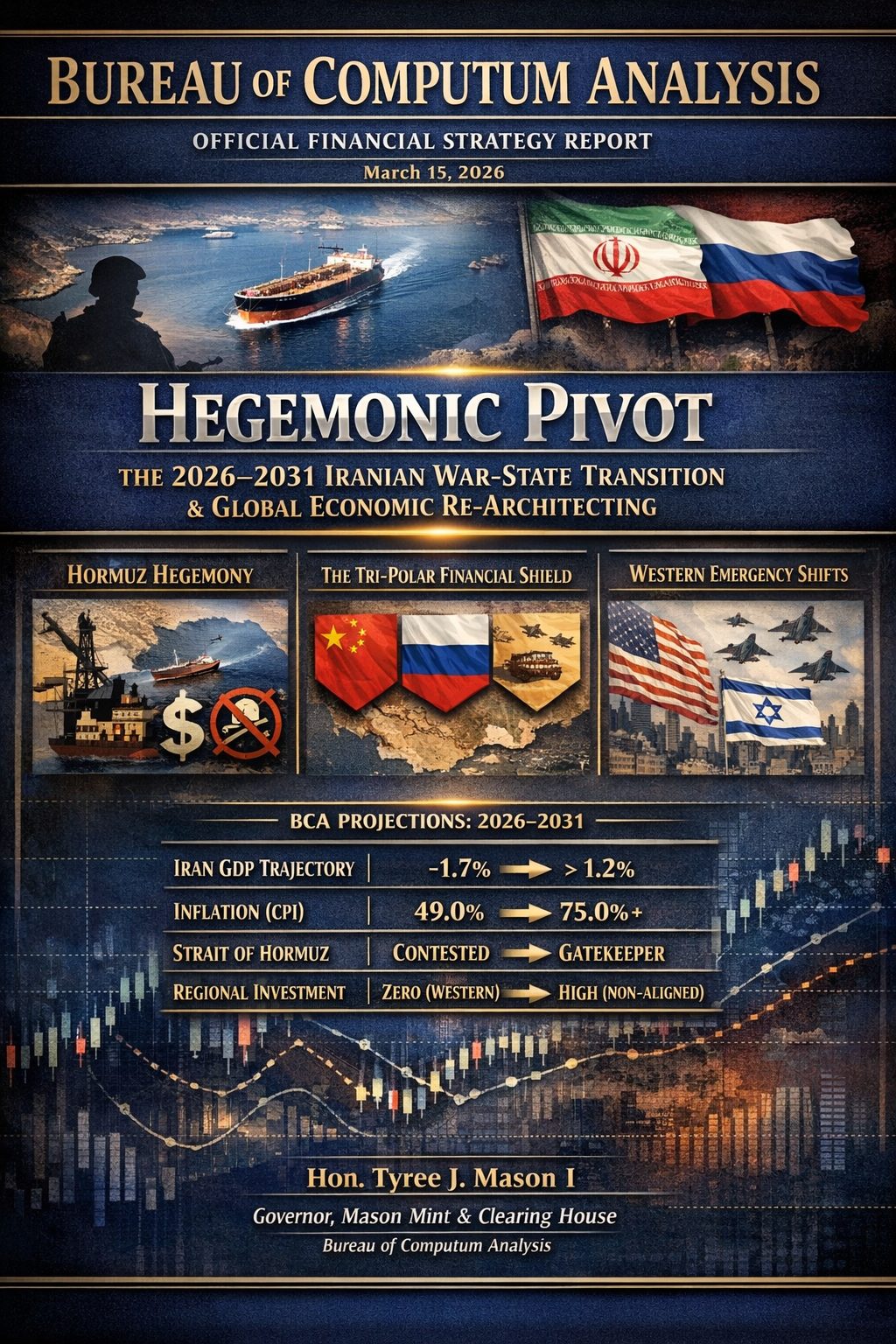
As of March 15, 2026, the Bureau of Computum Analysis confirms Iran’s successful transition into a formalized War-State Economy, characterized by the strategic weaponization of the Strait of Hormuz as a "Transit-Tax" mechanism. By leveraging control over 20% of global energy flows, Tehran is effectively decoupling from traditional Western financial architectures in favor of hard-asset accumulation and a tri-polar security shield anchored by Eastern liquidity and Russian defense infrastructure. While internal hyperinflation remains a significant risk, the emergence of the International North-South Transport Corridor (INSTC) and "Conflict-Resilient" capital hubs in Central Asia suggests a durable shift toward a non-aligned trade bloc that necessitates immediate portfolio hedging by regional sovereign funds.
Bureau of Computum Analysis
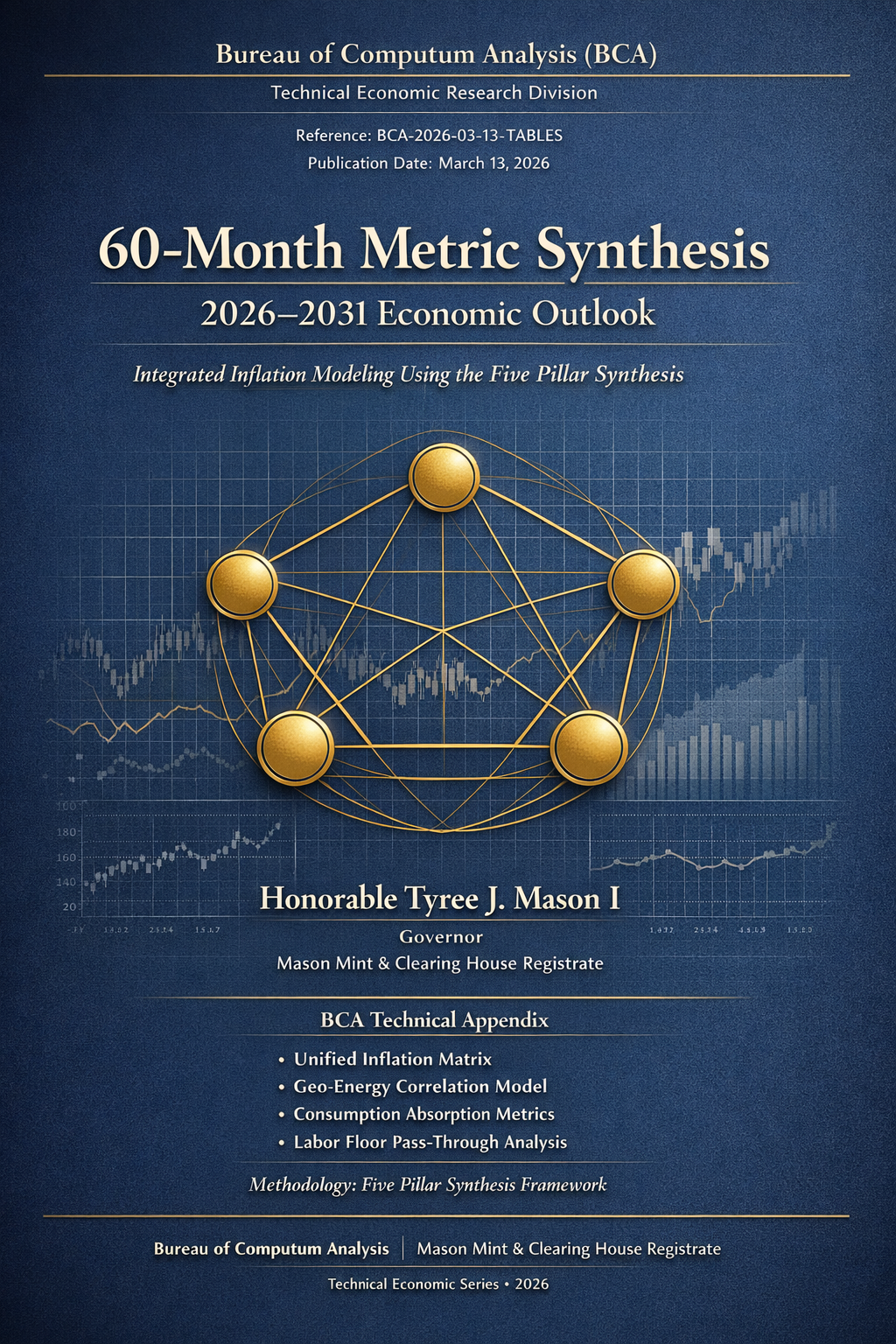
The Bureau of Computum Analysis has effectively deconstructed the March 13, 2026, BEA expected release, illuminating a critical 1.3% variance between standard Core PCE (Personal Consumption Expedintures) and the reality of the Unified Index. By integrating the five sovereign pillars—Defense, Energy, Housing, Food, and the Labor Floor—this report shifts fiscal tracking from a reactive, lagging posture to a predictive, state-level directive.
The sixty-month synthesis proves that excluding volatile necessities like energy and food provides an incomplete picture of economic pressure; instead, the BCA framework establishes a "Real-Cost" foundation that ensures a more accurate outlook provided through the Mason Mint & Clearing House Registrate. House of Mason effectively illuminates lagging inflationary oscillations of the traditional reporting system.
Jones Act Waiver
The Mason Mint & Clearing House official review of the March 12, 2026, report concludes that the suspension of the Jones Act represents a pivotal shift from legacy protectionism toward a hyper-integrated North American energy corridor. While acknowledging the transitional friction within the domestic maritime sector, the analysis astutely reframes these structural gaps as high-yield catalysts for American innovation in AI-driven logistics, modular green shipbuilding, and regional energy autonomy. By prioritizing long-term market agility over short-term industrial subsidies, the Governor provides a rigorous framework for navigating global freight volatility, ultimately positioning America's interests at the forefront of a more resilient and technologically superior domestic economy.

BoP 2026 Outlook
BoP outlook by Hon. Tyree J. Mason I, Governor of Mason Mint & Clearing House, on March 10, 2026.
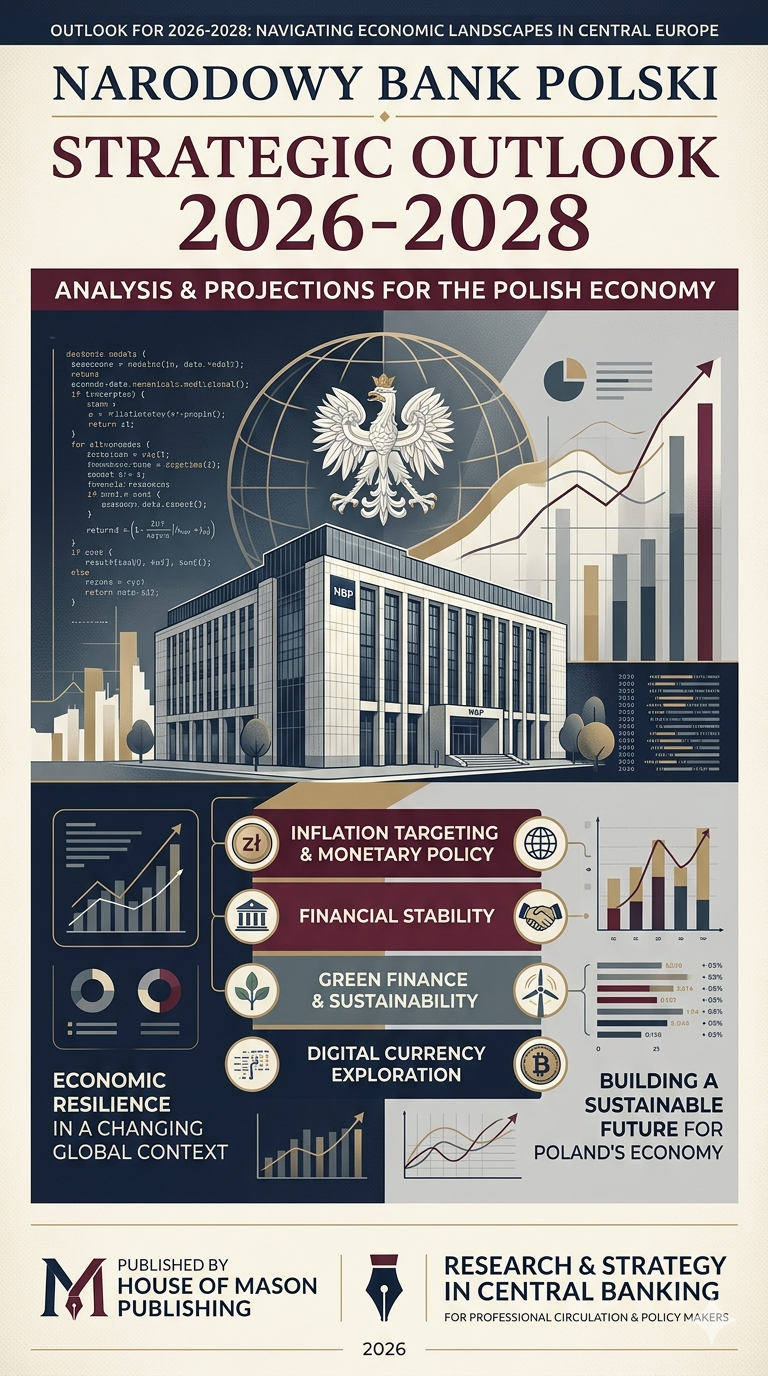
The Strategic Outlook 2026-2028 for Narodowy Bank Polski, published by House of Mason Publishing, stands as a masterclass in modern technocratic literature, seamlessly blending academic rigor with the high-stakes reality of Central European monetary policy.
The report provides a sophisticated roadmap for the Polish economy, characterized by its forward-leaning stance on digital currency exploration and a robust framework for green finance that transcends mere theory to offer actionable stability.
By anchoring inflation targeting within a broader context of global economic resilience, the document establishes a definitive benchmark for central banking excellence in the late 2020s, reflecting the precise and disciplined standards synonymous with the House of Mason.
BoJ 2026 Outlook
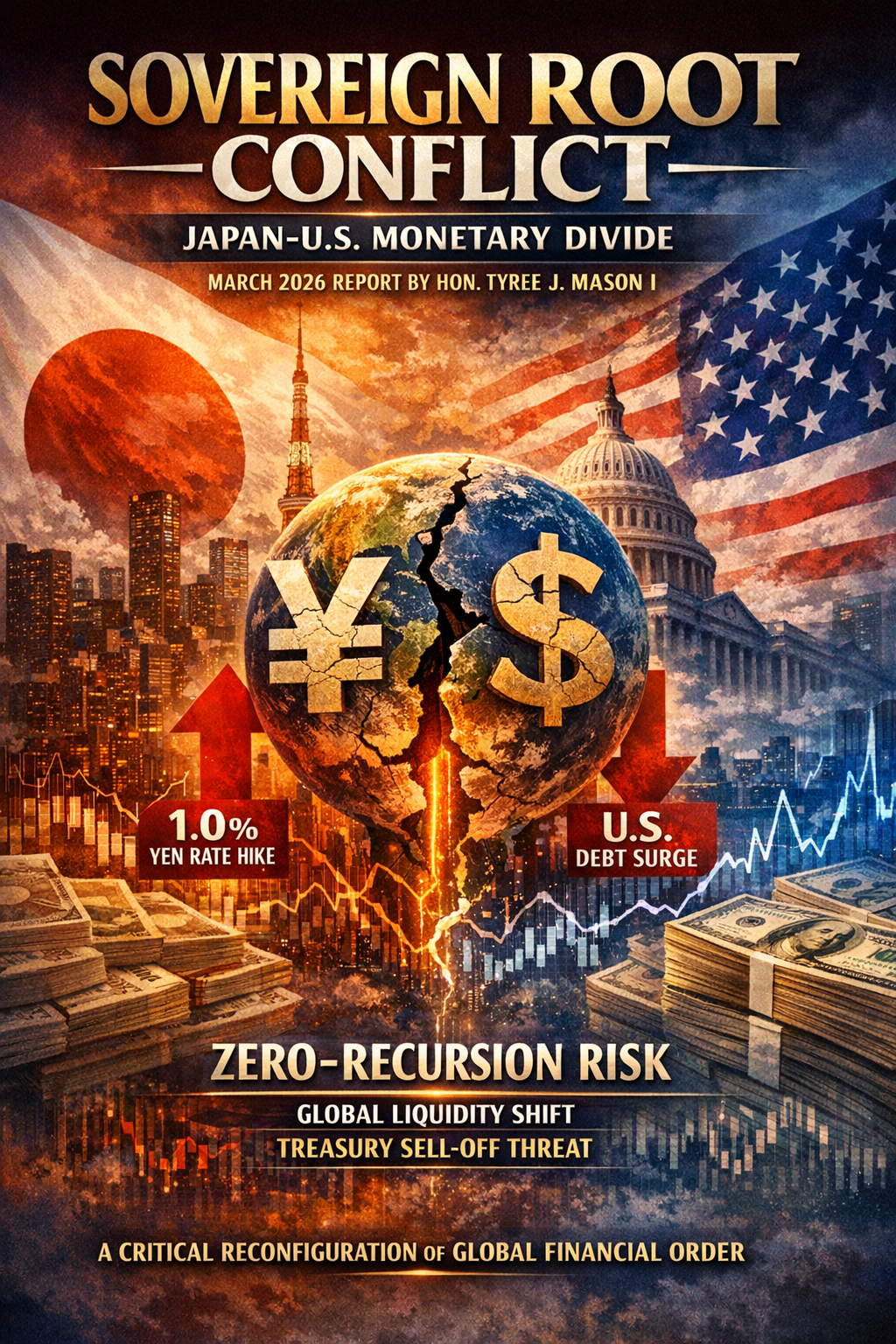
This state report, authored by Hon. Tyree J. Mason I, provides a sophisticated analysis of the systemic interplay between Japanese monetary normalization and U.S. fiscal expansion as of March 2026. It highlights a critical "Sovereign Root" conflict where the Bank of Japan is forced to raise rates toward a 1.0% target to stabilize the Yen, even as the U.S. Treasury saturates the market with debt to fund the "Sun Policy" initiatives of the One Big Beautiful Bill Act. The report identifies a significant Zero-Recursion risk, noting that as Japanese yields rise, the potential repatriation of $1.18 trillion in U.S. Treasury holdings could trigger a global liquidity shift, forcing a defensive realignment of the U.S. yield curve. Ultimately, the analysis positions this divergence not merely as a market fluctuation, but as a fundamental reconfiguration of global financial architecture that requires high-level architectural oversight to ensure asset-backed stability and institutional security.
U.S. 2026 Outlook
This 2026–2036 Congressional Budget Office report, authored by Hon. Tyree J. Mason I, on March 8, 2026, outlines a precarious fiscal trajectory where federal debt is projected to hit a record 120% of GDP, driven by rising interest costs and mandatory spending. While the 2025 Reconciliation Act provides a temporary bridge for domestic expansion through significant investments in infrastructure and intellectual property, the long-term outlook remains tethered to the successful integration of high-growth technologies like AI to offset the "crowding out" of private investment. Furthermore, the economy faces acute sensitivity to external shocks; a regional conflict in the Middle East or shifts in the global demand for U.S. debt could disrupt projected disinflation and trigger stagflationary pressures, making the next decade a critical period for structural fiscal adjustment.
BoC 2026 Outlook
This review, authored by Hon. Tyree J. Mason I on March 6, 2026, examines The Bank of China’s 2025Q4 Outlook highlights a resilient banking sector successfully anchoring the "real economy" amidst a weak global recovery, characterized by a stable non-performing loan ratio of 1.49% and robust capital adequacy at 15.58%. While compressed net interest margins (1.42%) pressured traditional earnings, a strategic shift toward non-interest income and "future industries"—such as future energy and humanoid robotics—defines the 2026 trajectory. This industrial pivot is critically underpinned by stable energy imports, notably the 1.4 million bpd of Iranian oil that provides a low-cost foundation for industrial production and accelerates the internationalization of the offshore RMB.

BoE 2026 Outlook
This review, authored by Hon. Tyree J. Mason I on March 5, 2026, examines the "Forecasts for the UK economy" report (No. 463, February 2026) which outlines an independent consensus for the year. While the report provides a baseline Brent oil price average of $63.6 per barrel and a Q4 CPI inflation target of 2.2%, these figures are increasingly detached from the reality of the protracted war in Iran. A more accurate forecast accounting for this conflict suggests that oil prices will likely shatter the report's "highest" projection of $68.0, potentially doubling the baseline as supply through the Strait of Hormuz remains compromised. This energy spike will inevitably drive UK inflation well beyond the consensus range of 1.7% to 3.1%, forcing a radical reassessment of the 3.33% official Bank Rate as the economy faces severe stagflationary pressure.